Showing posts with label film. Show all posts

Sunday, March 16, 2008

Eggs. A golf-club. A remote control.

Why did I watch Funny Games, Michael Haneke's 1997 psychological, meta, 'horror' film'? The answer is simple; the director's shot-by-shot remake arrives on Irish shores soon (it opened this weekend in the States) and I wanted to watch the original before I saw the new version, because I'm nerdy like that. After watching it, I'm excited about seeing the new one. The draw of seeing how Tim Roth and Naomi Watts, two fine actors whom I like very much, react to the awful events that they are subjected to, is substantial. Naomi Watts, incidentally, is one of my Actress picks (see below) and while I very much doubt this will win favour with the Academy, I have a feeling there'll be a rigorous campaign and critical buzz attached to it. From the trailer and a few screengrabs which are floating around the net, the remake looks very clean and bright, unlike the original (a stupid point, perhaps, but I dig the white, crisp streamlined look that's such at odds with the dim graininess of the original). Plus, it's in English, which will add an extra dimension of unease to my viewing. While the original's German created an extra welcome barrier between me and the characters, I have a feeling the harsh starkness of hearing their pleas in English will have the adverse affect. Before last night, I had never even heard of Susanne Lothar and was only marginally familiar with Ulrich Muhe, but I've seen Naomi Watts and Tim Roth countless times. I don't know if this'll will add to or detract from the terror, but we'll see.

The premise of Funny Games is simple. Two eerie, polite men in their 20s terrorise an affluent family of three in their summer house. That's it, really. By that description alone, you'd be forgiven for assuming it was your run o' the mill genre flick, a "torture porn" film created for and by those with the adolescent boy mentality. Well, you'd be forgiven until you saw the name Haneke was involved. If you're at all familiar with the Austrian director, you realise that what you're getting into is something much more intellectual, more challenging, more infuriating. More disturbing. And let me warn you, although nearly every instance of violence occurs off-screen, this film is disturbing. Muttering feverently under your breath disturbing. Nails digging into palms disturbing. Clutching a soft, cuddly toy like you haven't clutched so hard since you were a toddler, disturbing. At one point, I found myself singing softly under my breath as a means of half distracting myself! It's not just because of the "your imagination is scarier than anything a director could construct" old chestnut that is regularly trotted out. This clichéd maxim readily applies to FG, but the feeling of unease that this film generates is not because of that alone. The creeping dread that descends over you has to do with the way in which the film implicates you in the violence. You're the voyeur, you're the one causing these awful events by the very fact that you choose to watch this film. That's another point, you never forget that what you're watching is a film.
It's unrealistic and uber-stylized. There's a scene (I won't say what it is, but if you've seen it you know what I'm talking about) where Haneke pretty much gives his audience the finger, messing with your head and your preconceptions of what a film should be. Apparently, this scene is the reason why people have such negative reactions to the film. I can understand this stance, but it didn't make me hate it. In fact, the scene made me appreciate the film more; by not allowing the narrative to function as a straight-forward film, it made it clearer that this was something to be appreciated as an intellectual exercise, rather than a thriller in which good prevails, the bad guys get their come-uppance and all is right with the world.

By the film's end, I felt hollow, but not unhappy. I wasn't trembling and I didn't require a viewing of Clueless or The Incredibles, both of which I had lined up in case I needed a post-viewing boost. It was difficult to fall asleep afterwards, but because I was thinking about my reaction to the film, about what it all meant, about how people would react when it's released here. I wasn't terrified of two men breaking into the house (although I do admit that the shot of the golf-ball rolling in a slow circle on the wooden floor will stay with me for a good while). I do get the feeling that I'm not exactly the target audience. If the film is intended as a polemic against those who queue in their droves to watch teenagers be slaughtered, the "gore hounds", the people who really appreciate a good finger-slicing scene, I'm not included in this category of film-lovers. Running quickly through a mental list of my favourite films, violence only lurks at their peripherary and gore is almost non-existant. I've never responded well to acts of onscreen violence, ever since I watched Scream at a sleepover when I was 11. The scene where Drew Barrymore is being dragged across her lawn with a hook in her neck, whimpering scratchily to her parents, stayed with me for a long time....I've still never gone back and watched that film because it upset me so much the first time. Undoubtedly, it's probably a lot tamer than what I've imagined, but I still have no desire to revisit that scene. That's the same reason why I've never seen a "Saw" film, why I don't ever plan to see "Cannibal Holocaust" or "I Spit On Your Grave", why horror (with a few notable exceptions) isn't usually my cup of cinematic tea. If I were somebody who enjoyed this, I daresay I would have been even more disturbed and uncomfortable with this film, but I'm not and I wasn't.

I wouldn't recommend Funny Games to everyone, not by a long shot. I wouldn't even say I enjoyed it, per se, but it does provoke a reaction. By holding the camera still for interminably long sequences, for sustaining a fine balance between horror and ridicule, for treating the viewer as an accomplice (and not a very bright one at that), Haneke's film forces you to question the reason for your viewing of it, bullies you into thinking long and hard about the art of film and violence and the way in which the two intertwine. For me, it dredged up that memory of Scream, which I hadn't really given any thought to for years. I don't regret watching it for a second, although it was sometimes unpleasant.

The trailer for the remake is weird. Seriously, "In The Hall of the Mountain King"? Cheesy as all hell, that piece of music is. I'm guessing that's just something they've added in for the trailer, because if Haneke has included it in the film, he's probably lost his marbles. The overwhelming silence is such an integral part of the original and its inclusion in the trailer is completely overblown and hilarious. That said, the much-admired poster is truly something.


Friday, February 29, 2008

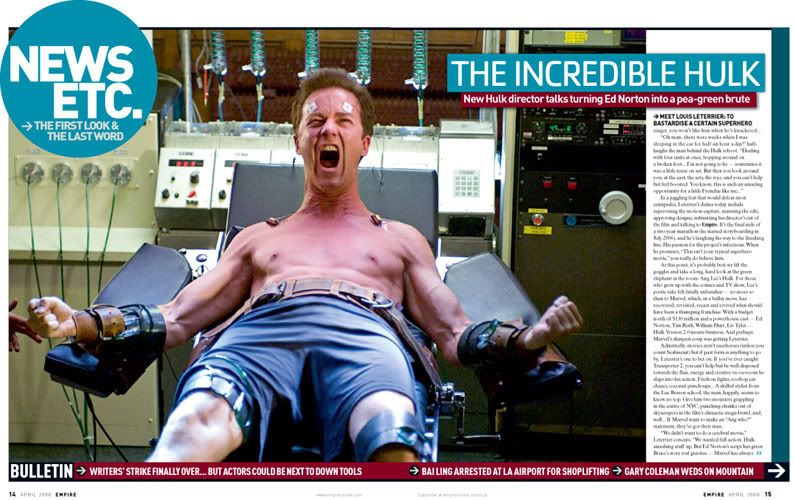
Ed Norton as The Hulk

This is what Empire Magazine just sent to my inbox. I think that's the first picture I've seen of him actually...Hulkifying. The only other still I've seen is that old one with a pensive Norton gazing into a glass vial. The email included a quote from The Hulk's director, Louis Letterier; "We didn't want to make a cerebral movie...Admittedly, I'm not the most adult director, but just because we're making a superhero movie, it doesn't just have to appeal to 13-year-old boys. Ed and I both see superheroes as the new Greek gods, so there's a classical undercurrent to Bruce's psycho-drama. It's Prometheus, Pandora's Box, Hercules...but with explosions!". A film starring and written by Edward Norton can't help but be cerebral, I think - but this sounds like a good sign that they're not taking this too seriously. If The Incredible Hulk turns out to be something akin to Spiderman or X-Men II, consider me intruiged. The supporting cast seem interesting as well; Robert Downey Jr, Tim Blake Nelson, William Hurt, Tim Roth and...Liv Tyler? I had completely forgottten she was an actual actress and not an elf.

Sunday, February 17, 2008

Oh no you didn't...

Sure, Hollywood has occasionally served up edgy female outcasts, such as Winona Ryder in Heathers or the forlorn geek girls in Ghost World played by Scarlett Johansson and Thora Birch. But those characters were more weirdos than antiheroes. - EW's Juno article

Dismissing a film's predecessors (whom it obviously owes a LOT to, btw) and insinuating that Juno McGuff is somehow better than Veronica, Enid and Rebecca in two throwaway lines? Nice one, Entertainment Weekly. I don't buy that Juno is an antihero (this is one of the many threads not fully developed in the film - she's presented as this 'wacky loner!' but is then, inexplicably, best friends with a cheerleader, not traditionally the company kept by cinema's oddballs), but she is sarcastic and intelligent and funny, like the girls in Ghost World and Heathers. Blithely chucking away their legacy as "more weirdos than antiheroes" - could somebody clarify what the hell that means? - is just rude and dishonest.


I liked Juno. I liked it a lot, actually. But I have one large quibble with it; Ellen Page's smart-alecky Juno is not the definitive voice of my generation. I'm two years older than Juno and her friends were supposed to be in the film, but if anyone had ever said "Honest to blog?" to me, I would've been horrified. Same goes from the forced ebonics that are so laboriously ladled onto the script, in a film utterly devoid of black characters or black culture, it just looks embarrassing. I'm less appallled by the barrage of pop-culture references, everyone has certain films/tv programmes/whatevers that they quote from, regularly and often tediously, (why hello Mean Girls!) but it's not the be-all and end-all of a person's character. I liked Juno best when she was chatting honestly with her father or Bleeker, rather than namedropping Iggy Pop. It's a frivolous worry, but I'm concerned that Juno's tastes will be absorbed by osmosis by teenagers who couldn't be bothered formulating their own. A generation of girls who assume Sonic Youth are "just a bunch of noise"? Noooooo!*

But back to the original article. Like Juno, Veronica, Enid and Rebecca were all smart, individualistic girls with their own set of problems, interests and quirks. Acting like Juno is somehow a superior, more accurate portrayal of being a teenager is ridiculous. In my opinion, the earlier three were better developed characters, less like a fictionalised version of a smart-aleck teenager, more real and true-to-life; but in the Great Big Cinema High-School In The Sky, they'd all probably get along (or, at least have grudging respect for each other). Lord knows we already have a small enough number of interesting teenage girls in the movies; there's enough for one more without throwing the others out.

*I'm partly joking about this. The music of Juno is a topic for a whole other blog post, but the ragging on Sonic Youth was uncalled for!

Saturday, December 8, 2007

The Golden Compass (2007) Weitz

If The Golden Compass had been an hour longer, it would have easily been one of my favourite films this year. Director and screenwriter Chris Weitz should have believed in the strength of the material as strongly as Peter Jackson, Fran Walsh and Philippa Boyens did for The Lord of the Rings trilogy, letting the enormous back story, history and culture of the world seep into the film while giving the characters time to breathe before rushing into the next battle scene. It’s far from being a short film clocking in at just two hours, but it’s not lengthy enough to fully absorb us into the world. And, despite having never read the books, I can tell it’s a world that deserves to be as magnificent and enticing as Middle Earth.

Thankfully, the film is still more LOTR than Hogwarts or Narnia in the depth of story, visuals and general tone. The comparisons to the LOTR trilogy are numerous; from the opening image of New Line’s logo that still immediately brings to mind the trilogy (The Fellowship of the Ring was, I think, the first film in which I took note of the production company) to the presence of Ian McKellen (wonderful as the voice of the armoured bear, Iorek ) and Christopher Lee (woefully underused). Unlike Harry Potter, which mixes the mundane and the magical to comedic effect, The Golden Compass is fully immersed in its magical aspects. Set in a world parallel to our own, where our souls are represented as tangible animals called Daemons who walk beside us and the menacing Magisterium (a thinly veiled version of the Church) watch over everything, the story
concerns the orphan girl Lyra (a spirited performance by the “other” Dakota) who lives in Oxford under the guidance and tutorage of her uncle, Lord Asriel (Daniel Craig, who deserves much more screen time). To describe the intricacies of the plot would be futile, as I have no idea where to start, save to say it moves at a zippy pace, throwing out information at the viewer at a dazzling speed. If you’re unfamiliar with the source material, as I was, then you need to have your wits about you, paying careful attention at all times. Like the LOTR, the source material is heavily allegorical (although Tolkien would reportedly fume whenever anybody referred to his books as such) and this seems to be where many of the books fans get annoyed; in order to make the film financially viable, all mentions of religion and god were shaved off completely. I can understand how this would anger people, yet I don’t think the filmmakers completely disregarded this integral element. Although it is never explicit, it must be very obvious to the more thoughtful members of the audience that the Magisterium stands for organized religion and that their policy of severing children from their Daemons is a pretty blatant statement about how religion cuts off our faculty for independent thought and free will (at least, that was my spin on it. Not having read the books, I can’t be sure if this is the exact meaning, but it’s close enough). To many of the children sitting in the cinema watching this film with me, these subtleties were undoubtedly lost, but I would hope that their parents would have picked up on them. Laying on the subtext any heavier would have transformed the film into something completely different; but this is what we are given and we must judge the film on what it is, rather than what it isn’t.

What it is, is a solid fantasy epic, with terrific acting, lovely set-pieces and a welcome sense of threatening doom. The Daemons, although not always fully realistic in appearance, are a delight nonetheless; the human character’s interactions with their Daemons, especially in the case of Ms Coulter (Nicole Kidman, surely in line for some Best Villain award) and her spiteful orange monkey, provide some great cinematic moments. In Lyra, we have a fantasy film with a proper female heroine, plucky, inquisitive, brave and sometimes misguided. Dakota Blue Richards gives a vibrant, stubborn performance, creating a rounded character with plenty of faults as well as her considerable talents. Acting against an inanimate object isn’t the easiest job in the world, but her interactions with her CGI Daemon (voiced by, of all people, Freddie Highmore, who has suddenly become the requisite casting choice for every family film) and Iorek feel unrehearsed and natural. It’s certainly darker than most recent family film, with some frightening scenes in which I was genuinely troubled.

Great plaudits must be given to the production cast of the film. Despite its faults, one can’t deny it is visually stunning. Neither claustrophobically mal-lit nor aggressively bright; each location has its own distinctive lightning and palette; the costumes are both fully believable as wearable clothes, and marvellously over the top. The CGI for the most part holds together well. The parallel world is rendered in good detail (but it’s hardly, it must be said, Middle Earth) and there’s a playful spirit in some of the early scenes in Oxford, with the Daemons scampering around their humans, that are a joy to behold. This is sadly forsaken as the film progresses, and the two battle scenes are frustratingly cut short, leaving us with no real idea of their outcome. I had major problems with the very last battle; primarily because it seemed incredibly short and I had no idea who lived/died/was wounded etc, but also because when the witches and Gyptians and the bears banded together to fight a common enemy, the triumph and jubilation I was aching to feel wasn’t there. If we had been allowed more time to get to know these characters, to doubt their motivations a little more, then that final fight would have been breathtaking.

I left the cinema on a high, discussing the film with my sister eagerly as we left the building. We both had questions about the plot and faults to discuss, but on the whole she felt the same as I did about it; namely, WOW! Above all, I was left curious about the source material. If Chris Weitz’s film has accomplished one thing above all else, is that he has served to increase the appeal of Phillip Pullman’s book. Typing that sentence, I am wondering whether there are any kids in the world who haven’t read His Dark Materials, or whether I’m the lone freak. To be fair, I once began the first book when I was about twelve, but I then heard a radio interview with Pullman where he criticised some aspect of Tolkien’s writing and from thereafter I swore never to read His Dark Materials ever again (I was going through my hardcore LOTR phase back then). I’ve grown up a little since then, and my loyalties to Tolkien are no longer so fiercely defended. Watching this film has piqued my interest in something that had eluded me for years. In that respect, if no other, it has triumphantly succeeded.

As a last point, if none of that entices you to go see the film, please take this into consideration: you get to hear Ian McKellen say the line “You want to ride me, do you?” which made both me and my sister crack up, while everybody else either pretended not to get the joke or suppressed their giggles. Now there’s a reason to see the film.

Thursday, November 8, 2007

A new one from Jim Jarmusch!!!

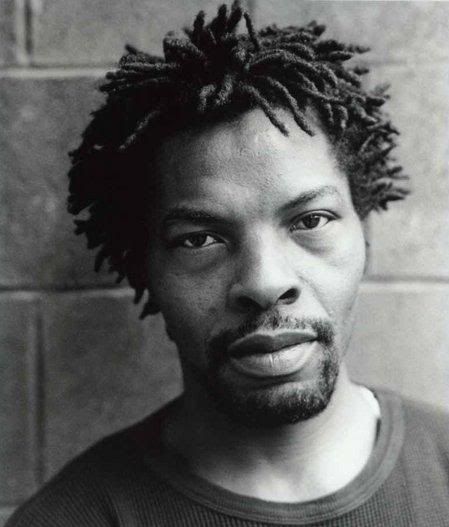
Sometimes a piece of news comes along to brighten up your day. Not that I was having a spectacularly awful day, but the news that Jim Jarmusch is about to start work on a new film has brought a huge smile to my face. The Limits of Control begins shooting in February and will star Jarmusch regular Isaach De Bankolé. Here's the official line, taken from Paste Magazine;

Jim Jarmusch's next project, tentatively called The Limits of Control, has been acquired by Focus Features for worldwide distribution. Jarmusch will start shooting the feature this February in Spain. It looks like Focus was happy with the reception of Jarmusch's last feature, Broken Flowers, so they're hoping for a similar success this time out. It's good news for Jarmusch, whose films have sometimes had a difficult time finding distribution, or at least advertised distribution, in the past.

Focus' CEO James Schamus remarked in a statement, "Jim Jarmusch defines what it means to be an independent filmmaker for audiences all over the world, and we're delighted to rejoin with him following our success together with Broken Flowers." That's only partially PR speak, since Jarmusch probably did as much for the creation of contemporary independent film as John Cassavetes.
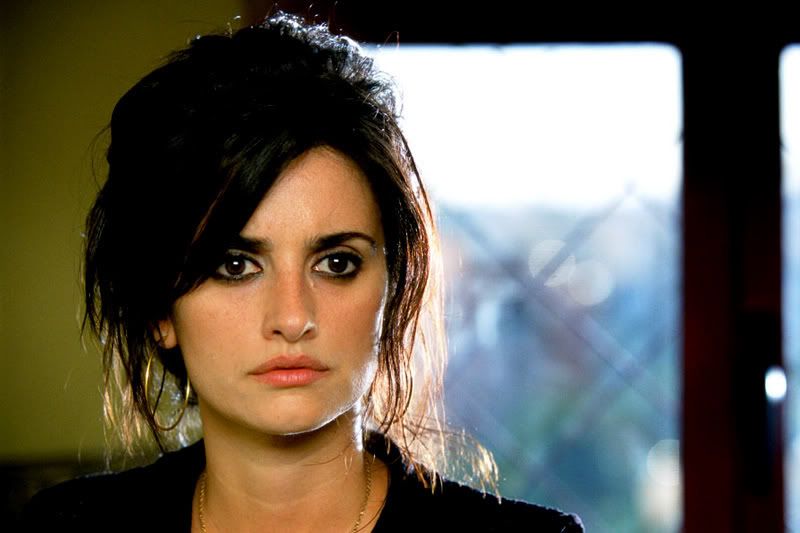
According to the film's press release, The Limits of Control is "the story of a mysterious loner, a stronger, whose activities remain meticulously outside of the law." Which makes him sound like nearly every other Jarmusch protagonist, but that's probably a good thing. He's played by Isaach De Bankolé (Raymond in Ghost Dog), and is completing an unexplained job that causes him to travel across Spain. The eminent Christopher Doyle (In the Mood for Love, Hero) will be working as cinematographer while Eugenio Caballero (Pan's Labyrinth) is production designer.

Nothing else is known about the film. All we can say here at Paste is that it's about time.

Broken Flowers didn't impress me. It was alright to sit through but afterwards all I was left with was a feeling of unbearable boredom. Bill Murray is severely overrated and that film did nothing for him and it's impressive roster of actresses (Swinton, Lange, Delpy, Stone) However, I adore Coffee & Cigarettes, Night on Earth and Down By Law. Jarmusch can swing between incredible tedium and greatness - often depending on his actors. Look at those involved in those three films; Tom Waits, Gena Rowlands, Winona Ryder, Roberto Benigni, Iggy Pop, Cate Blanchett (her short vignette in C&C in which she plays herself and her cousin, is in my mind, her best performance), Alfred Molina, RZA. A veritable who's who of cool in the film and music worlds.

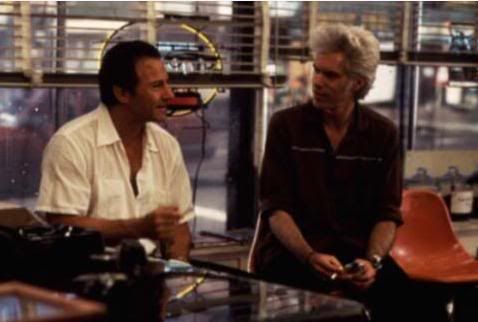
That reminds me of another Jarmusch-related oddity, the pair of films called Smoke and Blue in the Face. Their director was Wayne Wang, but Jarmusch appears in Blue in the Face and their inimitable feel of shambling NY cool is definitely part of his ethos. Never has a piece of entertainment seemed so engineered to my taste, gape at the ensemble of actors, musicians and writers that collaborated on them: Jarmusch, Harvey Keitel. Michael J. Fox, Lou Reed, Lily Tomlin, Stockard Channing, David Byrne and Paul "Godlike Genius" Auster. Wow, that's some impressive networking going on there. Smoke is the more conventional narrative film (as if anything penned by Auster could be called conventional) and Blue In The Face is a basically a collection of extras, leftovers, jokes and singalong.

Harvey Keitel and Jim Jarmusch in Blue In The Face

Oops, sort of got off the point there. I did have a point though, it being that part of the thing I loved so much about those films was their looseness, their humour and their sense of community. Broken Flowers left me cold. Here's hoping Jim'll revert to the old Jarmuschian charm.

Sunday, October 21, 2007

Three short reviews


Ratatouille
It seems as if I’ve been waiting for Ratatouille for years. Okay, a slight exaggeration but it certainly has been a long time coming. Pixar’s latest has only just got an Irish release (well, last week, but I only caught it today). It seems like an odd release date, perhaps timed hopefully to coincide with the up-coming half-term? It’s far from being a kids film, though - a lengthy running time and the absence of Finding Nemo-ish belly laughs take care of that. Indeed, in the cinema packed with kids that I attented, the film’s soundtrack was complemented by a continous stream of chatter from the seats surrounding me. The noise was only a temporary annoyance, though - I was soon well and truly hooked, the delicate aromas of Pixar’s stew drawing me in.

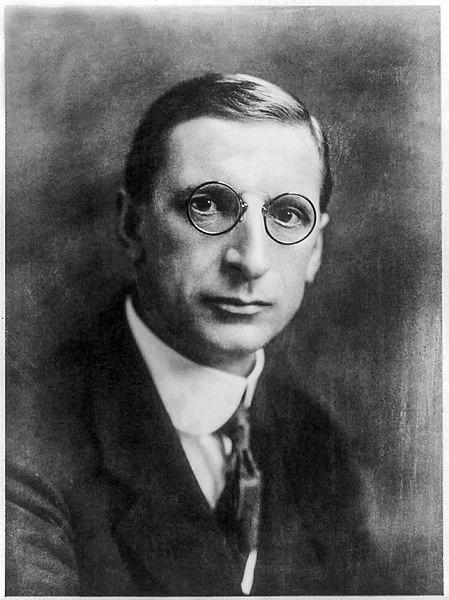
A truly lovely film, with the scenery the best we’ve seen yet. The grimey sewer water through which our snootily loveable protaganist Remy splutters and swims is rendered almost better than the underwater scenes in Finding Nemo; the CGI Paris glitters (okay, it’s hard to make Paris look bad, but they had to create one out of nothing) and there’s an impressive kinesis to it. The chase scenes are beautifully fluid with no Bourne-style jerkiness. Peter O’ Toole gets the best vocal part, having fun as the harsh food critic, Anton Ego (who is the image of Eamon de Valera. No? Anybody see that?). For Pixar devotees, there’s also a cute little self-referential sight gag; Remy straining to grab ahold of his brother’s paw as they hurtle down the river is strongly reminiscent of the ending to Toy Story.

Unfortunately, comparing it to Toy Story doesn’t do Ratatouille any favours. True, ToY Story came out of nowhere to charm and delight, nobody had any expectaions and therefore everyone was bowled over. It was shockingly good, and nobody could accuse Ratatouille of a similar effect - everyone expects it to be great, it’s Pixar! It’s definitely not as funny as it could be, the middle section drags a little and one could possibly accuse Pixar of resting on their laurels (oh goody, yet another anthromorphic buddy/outsider film!). I thought all of these criticisms whilst watching the film, but as the credits rolled I realised I was ready to forgive the film it’s missteps. There’s a scene where hundreds of rats converge on a restaurant kitchen and set to work cooking a meal. It’s a flurry of energy and joie de vivre, a huge undertaking of colour and movement and small significant details that’s carried off with such aplomb and verve that I was completely gob smacked. The teamwork (undertaken by both the rats as they frantically work to create the perfect dish and the animators as they carefully create the scene ) is astounding, and it was that moment that I finally caved in - Ratatouille is in it’s heart a good film and there are moments of brilliance. I’m looking forward to the studio’s next output - let’s hope they raise that bar.

Rendition
Sometimes I’m kind of shocked that some films get made, especially ones as topical as Rendition. It’s title refers to the US governmental practice of transporting terror suspects to offshore locations where shady thugs are given reign to torture and coerce them, with the freedom of ignoring the US constitution. Here, we are presented with the story of Anwar el-Ibrahmi, a handsome and clever Egyptian who has built a comfortable life for himself in the States, happily married to Reese Witherspoon and working as a chemical engineer. On his way home from a conference in South Africa he is bundled onto a plane to an unknown destination and merciliously tortured. The torture scenes are undoubtedly nasty, he is electrofied, beaten, forced to squat naked in a tiny enclosed space for hours and subjected to the especially horrific technique of waterboarding. It’s hardly the most violence we’ve ever been subjected to, but the fact that it’s based in reality causes many a squirm.

There’s a discomforting double standard at play though; Anwar is well-educated, married to a white woman and Americanized and we are clearly on his side, yet Khalid (Mohammed Khouas), the main character in the Islamic subplot, is (naturally) part of a Jihadist group. Why? Well, the filmmakers wanted to siphon in a handy father-daughter relationship theme and needed to show a human side to the lead torturer, of course and Khalid was the perfect sacrifice. It feels slightly wrong footed, attempting to show a reason behind the malice of the torturer by pushing the sympathetic Khalid into a terrorist group.

At the end of the day, the film stumbles on one major point - we are never told if Anwar is guilty or not-guilty. Well, the film makes it fairly clear that he is, but then where did the allegations come from? The main pieces of evidence used against him are records of his phone calls, but these are quickly forgotten about at the film’s close witout giving us any dislosure. If the phonecalls were fabricated by the government, desperate to find a suspect, then why weren’t we told? It’s a final cop-out and I really, really wish they had taken the final plunge and said “Anwar was singled-out purely for the colour of his skin”, if that’s what they were hinting at. The maddeningly even-handed script makes it explicitly clear that the process isn’t a new thing (“It began under Clinton”) but doesn’t once mention Bush by name, the President who intensified it. Rendition could hardly be called a brave film; it highlights torture, but ultimately fails to condemn it.

I didn’t thoroughly dislike it, though. As a thriller, it’s very taut and engaging. With strong performances from liberal-Hollywood types (Streep, Witherspoon, Arkin, brothers-in-law Gyllenhaal and Sarsgaard) and relative unknowns (Omar Metwally in particular gives good performance in a rough role that requires him to spend most of the film sweaty and naked, begging for his life), Rendition has a worthy gravitas that ensures that it’s a good watch. Sarsgaard may be the best thing about it, but Gyllenhall is also suitably worried-looking throughout and the final scene caused tears in my eyes. Out of the number of Iraq-themed dramas coming our way, Rendition will be far from the worst; it’s enjoyable and well-crafted, yet that final failing lowers it in my estimation.

Kings
I’m finding it very hard to get excited about this film. Solid acting, fine directing, a moving story and it’s lovely to hear Irish spoken on the big screen. Maybe it’s just not emotionally engaging enough, or perhaps I wasn’t in the right frame of mind to see it (it’s quite depressing, but not in the flamboyant way I enjoy, more in the Ken Loach way). There really is nothing especially wrong with it, but the fact that it has been chosen as the Irish Oscar submission hasn’t got me holding my breath.

Sunday, September 30, 2007

Michael Clayton (2007) Tony Gilroy


The summer film season is, by it’s very nature, a distracting force. Just remember our summer just gone; a veritable explosion of superheroes, car chases and giant robots. As we slipped into Autumn there came a handful of comedies headed by Seth Rogen, superficially different than the summer blockbusters but ultimately serving the same purpose, distracting people (in our case, a welcome diversion from the non-stop rain). There’s absolutely nothing wrong with setting out to make a film with the primary goal of entertaining people, but sometimes it’s more satisfying to make a film with something to chew on, a little moral ambiguity to get the brain cells churning. So, as the days get shorter and I get back into the routine of study, the cinema offerings get more serious, more literary, more intelligent. Basically, I’m in cinema heaven with the series of political thrillers and serious dramas like Breach, Rendition, A Mighty Heart and Michael Clayton either currently showing or on their way to the cinema.

Michael Clayton is the latest George Clooney vehicle showcasing his intelligence rather than his looks. It’s something I like about Clooney, that even in his most serious political roles he never seems preachy or even as if he’s grabbing for awards. He has a point to make and does so affably, it almost seems as if he isn’t really acting. In this respect, he’s the closest thing we have to a Cary Grant, somebody who just enters a film with enough self-confidence and charm to just be himself. As the eponymous character, a shady man who works as a “fixer” for a law firm, we never really get into the heart of his character, to discover what makes him tick. Personally, I was never quite sure what to make of him. In another setting this could be a problem, but in this case it suits the film perfectly, dealing as it does with lies and obsfucation.

Although Clooney is the film’s biggest sell, Tom Wilkinson delivers a standout performance as a corporate lawyer. His current client, a sinister multinational called UNorth, have murdered hundreds of farmers with a carcinogenic weed killer. Wilkinson eventually goes crazy and turns his back on his professiona duties after neglecting to take his manic-depression medication, a discomforting downward spiral of insanity. Part of Clooney’s job is convincing Wilkinson that his change of heart is a result of the resulting chemical imbalance, but to the viewer there is no doubt that it is the unbelievable guilt of compromising his morals day-in, day-out that has triggered the madness. The film’s best scene occurs with Wilkison, alone and raving in his apartment, playing UNorth’s advertising spot on repeat, the comforting words and images of small, multicultural children familiar to anyone who has ever winced at the friendly posturing of big businesses. The high-tech audio-visual equipment he uses have all been paid for with the blood of innocents, yet even this chilling scene never reaches the tense heights it could achieve. I have a feeling this is a deliberate move on the part of the director, the whole film is coated in a very slick, corporate feel which furthers the subject matter.

Bolstered by a fine supporting cast and a dense script, Michael Clayton is a head scratching treat. It won’t be for everyone, there’s little flashy or fun, and a quick glance on the IMDB boards show that many people consider it boring, but I thoroughly enjoyed it.

Monday, September 3, 2007

Back to school, yadda yadda

In honour of my (very) immenint return to school, I present my favourite cinematic schooling moments.

Donnie Darko: Richard Kelly’s directorial debut was an ambitious sci-fi that shot Jake Gyllenhaal into superstardom and left thousands of teenagers scratching their heads wondering what it all meant, but it’s crowning achievment has to be the single slo-mo tracking shot through Donnie’s high school. We meet his friends, the teachers, the school bully (who appears to be snorting coke...) and Jake’s future love interest, all set to the oddly apt strains of Tears for Fears. It’s one of the most perfect scenes in recent film history, settling nicely into the niche between the bizarre time-travelling plot and the pure weirdness inherent in high school.


Ferris Bueller's Day Off: An odd choice, as Ferris doesn't spend a second in school during the course of the film, but it's one of the highschool films. Who hasn't spent a mind-numbing maths class dreaming of going on the mitch with Ferris, Cameron and Sloane? It's such a pity that Ferris chose to skip on that particular day, as here's a glimpse of what was going on during the economics class:

"In 1930, the Republican-controlled House of Representatives, in an effort to alleviate the effects of the... Anyone? Anyone?... the Great Depression, passed the... Anyone? Anyone? The tariff bill? The Hawley-Smoot Tariff Act? Which, anyone? Raised or lowered?... raised tariffs, in an effort to collect more revenue for the federal government. Did it work? Anyone? Anyone know the effects? It did not work, and the United States sank deeper into the Great Depression. Today we have a similar debate over this. Anyone know what this is? Class? Anyone? Anyone? Anyone seen this before? The Laffer Curve. Anyone know what this says? It says that at this point on the revenue curve, you will get exactly the same amount of revenue as at this point. This is very controversial. Does anyone know what Vice President Bush called this in 1980? Anyone? Something-d-o-o economics. "Voodoo" economics."


The Breakfast Club: It's a tough choice between this and Pretty In Pink for the mandatory John Hughes flick, but for pure iconic status, it's gotta be this one. For honing in on the accuracy, and the stupidity, of school stereotypes (the jock, the princess, the weirdo, the nerd and the drop-out) and for the line "Does Barry Manilow know that you raid his wardrobe?", you can't beat it.


Clueless: It's been over a decade since Cher and Dionne shopped, gossiped and match-maked their way through high school, and the Valley-Girl vernacular is ridiculously outdated, but Amy Heckerling's sharp update of Jane Austen's Emma is still as funny as ever. Some of the fashion choices are priceless and it's high time "Betty" and "Baldwin" were brought back as synonyms for good looking people! Or maybe not. But hey, if we're ever faced with a tough opponont in a debate, we have Cher to look to for inspiration.


Mean Girls: Probably the best high-school film ever made. Certainly the best movie Lindsay Lohan ever made. And, wait for it, my favourite comedy of all time.

"You got your freshmen, ROTC guys, preps, J.V. jocks, Asian nerds, Cool Asians, Varsity jocks Unfriendly black hotties, Girls who eat their feelings, Girls who don't eat anything, Desperate wannabes, Burnouts, Sexually active band geeks..."


Sadly, "Fetch" ain't never going to happen.


Saturday, September 1, 2007

Breach (2007) Billy Ray

In a year dominated by great female performances (think; Laura Linney in Jindabyne, Marion Cottillard in La Vie En Rose, Imelda Staunton in Harry Potter, Maggie Gyllenhaal in Sherrybaby) it is somewhat of a relief to finally see a male performance that could be worthy of an Oscar nod come February. Chris Cooper’s turn as real-life FBI agent Robert Hanssen in Breach could well be one of the year’s defining male performances, although this muted, intelligent thriller could slip under many people’s raders.

Everyone has their favourite niche genres, whether it’s biopics of doomed musicians or high school comedies. One of my own personal favourite genres would be the political thriller; the recent remake of The Manchurian Candidate being a case in point. I had been an admirer of Bill Ray’s Shattered Glass ever since I saw it a few years ago and when I heard he was making another film based in reality, this time concentrating on the downfall of FBI agent Robert Hanssen, my interest was piqued. The cast list, when I saw it, only furthered my enthusiasm for this film; the excellent Chris Cooper, the aforementioned Linney plus a bit part for The West Wing’s nasty vice-president Gary Cole. There’s always a risk of being disappointed when you look forward to something, but Breach handles it’s subject with decorum and an unshowiness that betrays it’s sensational plotline. It’s smart, well-acted and emotionally involving; a welcome change from the candy-coloured assualt of the summer film season.

In 2001, FBI hopeful Eric O’ Neill was assigned to work alongside Hanssen in order to find out his secrets. At first, O’ Neill is only told that Hanssen is a sexual pervert and that his mission is to investigate any deviant activities in order to save the FBI from any potential embarrassment. As the weeks progress, O’ Neill (a surprisingly good portrayal by Ryan Phillipe) becomes fond of Hanssen and demands to know why he is supposed to be investigating him. Reluctantly, his supervisor, Agent Kate Burroughs (Laura Linney) explains the true reason; Hanssen has been working as a spy for Russia for years, divulging vital pieces of U.S. intelligence and authorising the killing of other agents. He is a traitor and a liar.

Cooper, who has made a living playing hardened men (American Beauty, The Bourne Supremacy, Jarhead) is the unbreakable core of the film. Hanssen is obviously an extremely complex man; a devout Christian who has no qualms about betraying his fellow country. At times he seems without morals, but then a small touching gesture he makes towards O’ Neill will flip your perception of him uncomfortably. We are clearly not supposed to empathise with him, he is cruel and perverted, a heartless liar, but Cooper gives such a lifelike potrait it is difficult not to feel some glimmer of sympathy. None of the other characters know what to make of him either. “His grandchildren do love him,” admits Agent Burroughs reluctantly. It isn’t a showy performance by any means, but you can hardly keep your eyes off him. He exudes quiet menance from our very first encounter with him and O’ Neill, understandably, is terrified. He is the scariest onscreen Boss since Miranda Priestly in The Devil Wears Prada, except Anna Wintour never sold secrets to the Russians. At least as far as I’m aware…

The Bourne Ultimataum, which I also enjoyed, deals with roughly the same topics as Breach; CIA, espionage, secrets. But it’s hard to think of two such dissaparate films. While the Bourne films are a frenzy of jump-cuts and wobbly handheld cameras tracking impressive car-chases, Breach is a much quieter affair. The bulk of the action takes place in offices or apartments, there is no final showdown, no jolting cameras or frentic electronic scores. It is character based, dialogue based; and even the more chilling for it. The tension builds up slowly throughout the entire film, beautifully realised in muted greys and blues, until the inevitable end rolls into place with a saddening clunk. Breach is not an uplifting film, but nor is it a downer; it simply understands that people are complicated in what they do, in what they say and what they think.

“It doesn't really matter; the judgement of other men... I know what I've done.” - Robert Hanssen, Breach.

Monday, July 16, 2007

Badlands (1973) Terrence Malick

I’ve seen a multitude of films over the past fortnight (including Paris, Je t’aime, Shrek the Third, Harry Potter and the Order of the Phoenix, Gloria, Of Human Bondage, Punch Drunk Love and welcome rewatchings of Adaptation, Moulin Rouge and Eternal Sunshine of the Spotless Mind ) and my typing fingers have been itching to review something but inspiration kept failing to strike. Finally, a suitable subject on which to expound hit me like a gunshot in the stomach - Terrence Malick’s Badlands which I watched late Friday night. Perhaps later than I should have, lying flat on my bed with the laptop on my stomach, sleepy head propped up by pillows so I could see the screen. But my lethargic state only endeared the film to me even more than it would have otherwise - I was so undistracted by anything other than what was directly in front of my nose that I was free to wallow in the expansive shimmering scenery that rolled across the screen. It’s a rich, ponderous film that overwhelmed me with it’s beauty before digging me sharply in the ribs; a heady cocktail of dangerous substance. I felt like Sissy Spacek’s Holly, a dreamy-eyed 15 year old, swept up in the glamour and freedom of murder.

In the film, Spacek is seduced by a local garbage man who keeps to himself, a whippet-thin local boy who struts around brooding like James Dean. I can’t even begin to describe what a thrill it was to witness Martin Sheen, decades before the White House came a-knocking, looking younger than he has the right to. He plays the homicidal lunatic with such cool detachment and reckless abandon but such sweet naivety it’s hard not to fall in love with him. Based loosely on the story of Charles Starkweather, a 1950s serial killer (in the film named Kit Charles) who fell in with a teenage girl, murdered her father and set off on a road trip through America. Terrence Malick changed the names (and probably a lot more besides), but factual verification means nothing in a case like this; this film is what cinema was made for. If I had seen it on a large screen, it probably would have knocked me out cold.

When something affects you, it’s hard to detach yourself so completely you can write about it in a rational manner. I’m trying to say intelligent things about the film, but all I can do is throw superlative adjectives at it and hope for the best. It’s rare that a film ever gets everything so right - be it the quiet grandeur of the cinematography showcasing the magnificence of the American scenery, the spot-on casting of Spacek and Sheen, the intentional misplaced jollity of the score, the otherworldly feel captured in Spacek’s innocent voice-over…sigh. The more I think about the film, the more I like it. Despite it’s obvious moral issues, Kit is actually a decent fellow with sound advice (if you ignore the fact he murders folks) to spare, he genuinely cares about Holly and illustrates the importance of staying true to one’s self.

When I was younger, all my favourite kid’s books were set in the USA. I was snobbish about most Irish children’s novels - I wanted to be friends with Ramona Quimby, not Rosie. Sesame Street was my ideal home (how dare they take it off air? who cared if not all the lessons applied to us across the ocean?) The allure and mystique of the U.S. never really left me, not even when two disastrous presidential terms sullied the nation’s reputation in the eyes of the world. It became ridiculously fashionable to denounce America and a lot of people got off on feeling superior to them. This anti-American intent grew and grew until some people were acting as petty and bigoted as the traits they claimed to despise. I don’t mean to overly praise the country, lord knows they’ve majorly fucked things up recently, but this is the land that gave me Arrested Development and The West Wing, Paul Auster and Douglas Coupland, Bette Davis and Jimmy Stewart, Nirvana and Tori Amos. It’s been a dream of mine for years to visit New York (although I fret that my experience could hardly live up to my expectations) and to go on a sprawling road trip; in short I am brimming over with good things to say about the country and somehow Badlands crystallised all this into one film. It’s the ultimate road trip, chewing up pop culture and spitting it out, reminiscent of both Bonnie & Clyde and Thoreau’s Walden, showcasing youth, death, murder and the importance of living life to the very full, toying with the audience’s expectations. It’s at once both relentlessly cinematic and somehow broader than a screen. It’s a living, breathing thing. When it came to it’s perfect close, I was left watching the credits pass by, as similarly dazed as I was by Jindabyne.

It’s rare that something can hit you as much as this did me, but when it does you’ve got to be grateful. Boy, am I ever grateful for Badlands.

Friday, June 29, 2007

Children of Men (2006) Cuarón


Wowzer. I have no idea why I resisted seeing Children of Men for so long. When the trailer was initially in cinemas, I thought it looked great and had an interesting premise, but when it finally landed I was just apathetic about seeing it. Probably didn’t have the funds or maybe just lack of incentive, either way I left it and then forgot about it until happening across it in the dvd shop yesterday. I couldn’t see anything better to rent, so I came home with CoM.

And I was blown away.

It had it’s flaws, there’s no question about that. There were certain plot points that I didn’t fully comprehend - why was Kee the only woman able to conceive for 20 years? What exactly was the immigration problem about? Who were the Human Project and what was their purpose? - but overall these discrepancies just added to the bleak disorientation of the film. For the uninitiated, Children of Men is the filmic adaptation of P.D. James’ dystopian novel. It takes place in Britain of the future, which by the year 2027 has been rendered a living nightmare. Chaos reigns with secret societies abound, London has degenerated into an urban wasteland and for some unexplained reason, women are no longer able to give birth. The film opens with the death of the youngest person on earth, an 18 year old boy named Diego. This death creates a minor ripple through a world already disaffected and devoid of hope.


From the very beginning, director Alfonso Cuarón grabs the viewer by the hand and hurtles us along the rollercoaster ride from hell. Explosions rip half the screen apart, but these are no Michael Bay-type booms, these are gut-clenching explosions, truly frightening and strangely beautiful. Blood splatters out and actually remain on the camera for an excruciatingly long take in which I just wanted to applaud long and hard. There is no easy way out; important, sympathetic characters die or get carted off and it all seems awfully bleak and disturbing. At the same time, our protagonist, Theo (a wonderfully on-form Clive Owen), is the perfect anti-hero, a gruff, bemused loner who’s lost everything and therefore has nothing left to lose. Unwittingly, Theo gets thrown into dealing with a covert operation who have uncovered a young woman, Kee, who is inexplicably pregnant. His ex-wife, Julian (Julianne Moore), who is the leader of the terrorist group known as The Fishes, adds some fun to the proceedings - her scenes with Theo are sweet and touching - until things turn nasty and Theo is forced to go on the run with Kee. It’s a dangerous journey that takes them deep into the heart of the urban jungle, filthy and depressing and achingly human.


It’s in the little details that Children of Men triumphs. Theo’s escape is so hurried he doesn’t even have time to find his shoes and spends most of the movie in a muddy of socks or a pair of dodgy sandals borrowed from his ageing hippy friend Jasper, a hilarious Michael Caine. Caine is a pure delight whenever he is on screen; he’s a stoned joker who holes up in the woods to listen to Aphex Twin and Radiohead, but the photographs and newspaper clippings that litter his cabin betray the hardship that lurks beneath his funny veneer. The London of 2027 is startingly rendered; background signs and thoughtful graffiti add a realistic depth and I’m sure that one could not possibly pick up on all the details through one viewing. It’s a technical dream; the cinematography does not rely on sunets or beach scenes to be beautiful and the lighting is similarly striking. There are numerous scenes that I found just fascinating to look at; the room in which Theo is kidnapped, the walls covered with newspaper, the whole scene in the car which begins lighthearted and funny and descends into one of the most heartwrenching scenes I've seen in a long time, the very last shot etc.

Despite it’s brutality, Children of Men never gives up on humanity. It is pure, visceral filmmaking with a good heart, an eye for the cinematic and a central character who is flawed, lonely, depressed and heroic. What more would you need in a film?

Tuesday, June 26, 2007

Coming Soon (In my head?)

I just had the strangest experience. I woke up at 9.20am, switched on the radio and promptly fell back asleep. Then I woke up again and walked downstairs, where the kitchen clock read 7am. Confused, I wandered around the house, had a conversation with my dad and then retreated back to bed where I heard about a new film starring Tom Cruise entitled "Valkyrie". It was about the failed assassination attempt on Hitler's life. Then I saw a clip (even though I was listening to the radio, this is when I should have twigged that something was up) which looked like the leftover set from Blackadder Goes Forth. Tom Cruise, in shoddy Nazi regalia, was standing in the centre, as other soldiers clicked away on the laptops in the background. "Hitler iz comingz!", one of the Nazis informed the camera. Then, "Vee haff done ze background check on ze Scientology, it iz not a real religion!". NaziTom looks crushed. End scene.

Then, after this fabulously anachronistic piece of cinema, I woke up. It was just gone 10am and I had a sore throat. The radio was still squawking, film reviews as it turned out. I thought to myself, "Okay, I've just dreamt a made-up film". Now, I google "Tom Cruise" + "Valkyrie" to see that it is an actual film, although maybe not exactly how it was like in my dream.

The lines between fiction and truth are blurred so much now that I don't know what's going on.

La Vie En Rose (2007) Dahan


I’m listening to Edith Piaf as I’m writing this review, which is probably not a great idea. Arguably the best vocalist of the 20th Century, Piaf has such a distinctive, rousing style that it will prove difficult to differentiate the music from the biopic of Piaf’s life; the great songs from the frustrating film, as it were. It would be easy if I simply ranted about the film, which suffered from many missteps, but I’m not going to as I really quite liked it.

La Vie En Rose is the latest in sob-story musician biopics (Ray, Walk The Line) to lay itself bare across our screens. The musician in question must have had a life filled with melodramatic happenings, tortured love affairs, redemption and above all, great music. Edith Gassion had a natural foothold above Johnny Cash et all, as her life was almost unbelievably tragic in it’s emotional scope. She lived during one of the most turbulent times in modern history (France during WWII), her formative years were spent on the streets/in a brothel/with a travelling circus, her parents deserted her, the love of her life was killed in a plane crash, she herself was injured in a car accident, she suffered from crippling disability and arthritis, she had cancer and was accused of being both Nazi-sympathiser and a murderess. Oh and yes, she was also temporarily blind and deaf as a young girl. Any one of these misfortunes taken on their own would be enough to feel sorry for the woman, together, they add up to something Pedro Almodovar would reject as being too melodramatic. Personally, I feel that the amount of misery that the poor woman endured just cannot be properly executed in a 2 ½ hour film and unfortunately I was proved right - we are presented with scene upon scene of disaster, in a seemingly random order. With La Vie En Rose, screenwriter and director Olivier Dahan had an abundance of scenarios to choose to adapt for the big-screen and it feels like he just gorged on Piaf’s life without any semblence of thought to coherent storytelling or audience understanding. Characters appear and leave without leaving enough time for us to really know them or figure out the role they play in Piaf’s life. Her best friend, Momone, is given a good bit of screen time and her character is interesting (not to mention well-played), but the non-linear storyline jumps around so much that her own plotline makes little sense and we never get to experience their longtime friendship in a satisfying way. Scenes of the singer as a spry twenty-year old, running around Paris in a joyously exuberant manner are intersected with Piaf as an incredibly shrivelled woman, bitter and drugged-up in a nursing home. This results in disorientating and distressing the viewer, as we are never fully sure where we are, and for the multitudes of viewers who are not extremely well-versed in her life (myself included) it leaves us frustrated and wanting more.


This is my biggest quibble with the film and if it weren’t for it, La Vie En Rose would be one of the best films of the year. As it happens, the only thing to do is sit back and enjoy everything else that the film throws at you; which luckily includes wonderful performances, gorgeous costumes and lighting, and an infectious spirit. The early scenes set in the dingy streets of pre-war Paris are especially notable for their unbridled grubbiness (good thing Smell-o-vision never really took off as an idea in cinemas) and any of the scenes in the nightclubs exude a dirty bohemian glamour that is very appealing to watch. The costumes, sets and lighting give off a reality based quality that is never uncinematic and you feel that real care has been put into this world. The music is, obviously, fantastic - having Marion Cotillard lipsynch to Edith Piaf’s actual recordings help to add authenticity and will hopefully introduce the music to a younger audience (although I guess a large bulk of this film’s ticket-buyers will already be seasoned Piaf fans). Whether it’s the beginning of her singing career when she is still perfecting her technique and bellowing out racous tunes on street corners or that final triumphant rendition of “Non, Je Ne Regrette Rien” (I was anxiously waiting for that one song throughout the entire film, sticking it at the very end was a good move), Piaf’s voice speaks for itself. The melody of “La Vie En Rose” subtly plays around the corner of scenes all through the story, thankfully adding some sense of continuity and reminding us that, despite it’s flaws, this is a film about one woman and her emotional life through which she prevailed.

Finally we come to the acting, and it must be said that Marion Cotillard throws herself into the role feet first and is an absoulte revalation. I mistakenly thought it was the first thing I’d ever seen her in, but IMBD tells me otherwise; she was also in Big Fish, Jeux d’Enfants and A Very Long Engagement, all of which I’d seen. It’s a shock to me, I still can’t equate the pretty, straightforward actress of these films (I had her down as an cheap Audrey Tatou for a while!) with this woman onscreen. Her CV includes a scattering of English language productions aswell as lots of French ones but her embodiment of Piaf is sure to catapult her into international fame. If she doesn’t garner an Acadamy Award for it, it’s just another indication of the Acadamy’s inherent xenophobia - and you can quote me on that.

A large part of her role has to do with make-up and prosthetics, a succession of wigs and toothy mouthpieces that could envelop a lesser actress but Cotillard takes all these extras and runs with them. It’s a magical blend of the absurdly physical (she has perfected not only Piaf’s token stage actions with the outstretched arms and gaze directed upwards, but her hobbled walk, the clownish downturn of her mouth, her sudden outbursts of violence) and the emotional (her Piaf has an enormous sense of fun and mischief, along with a cruel steak and a steely determination). Pushed onstage and told to sing, the young Piaf receives a standing ovation and looks simultaneously overwhelmed, delighted, proud and perplexed. There’s a touching awkwardness about her and I couldn’t help but warm to her and root for her, even when she was being difficult. Cotillard literally throws herself into this role, she staggers around in a slapstick fashion a lot but there’s real emotion and fear and love mixed in. There were certain points where I found her very difficult to watch, she allows herself to be extremely physically unattractive and at times frightening. This film could be smacked with a label warning for parents; this film is emotionally draining. Piaf may have been only 47 when she died, but her body was riddled with disease that she looked like a very eldery woman, and Cotillard effortlessly captures the withered body as well as the young woman of a few scenes previously. It is a fine, brave, respectful performance and I heartily endorse it.

All the supporting cast are strong although they are given too little to work with. Gerard Depardieu’s character is fun (I was literally dreading his arrival as I usually find him annoying, but he reigned it in a lot) and I was sorry to see his departure, Emmanuelle Seigner turns in a small but memorable role as Titine, the prostitute who mothers the child Edith and there’s a delightful part where Marlene Dietrich turns up (not the real Marlene obviously , due to her being dead, but one played by Caroline Sihol). I’ve already mentioned Piaf’s longtime friend Momone, played by Sylvie Testud, and my frustration that we didn’t learn more about her. Testud does an admirable job with limited source material and if a pivotal scene where Piaf dismisses her longest companion falls a little flat, it has absolutely nothing to do with the quality of acting on either part.

Reading the reviews afterwards (almost uniformly terrible, save for Roger Ebert who gave it an impressive four stars) I’m tempted to just go along with them altogether and say that the skewed chronology ruined what could have been a perfectly good film. I don’t disagree with this viewpoint, I was very confused by the sequencing at times, but I’m going to stick with what I felt in the cinema though, which was awe and delight. Yes, La Vie En Rose frustrated me, but it was also dazzling, beautiful and emotional. It will provoke a reaction whether you love or hate it - this is a troubled, inspired tribute to a troubled, inspired life.

Thursday, June 14, 2007

Guess what I just watched...


"Rosebud..."

Sunday, June 10, 2007

Jindabyne (2006) Ray Lawrence

Silence, lies, and the spaces between words; these are themes that respected Australian director Ray Lawrence explores in Jindabyne, a grown-up, mature piece of drama that doesn’t rely on flashy set pieces, extended violence or humour to make it’s voice heard. It is a quiet, unsettling film with some of the finest acting I have witnessed in a film this year (especially a new film). I loved this film, and I admired and also feared it, in a way.

In the film, four men go out into the country for a fishing trip. The buddies are in high spirits, glad to escape from the drudgery of work and marriage, but when they discover the body of a young woman floating naked in the river, the whole trip is laced with something rather more sinister. After discussing the matter, the men decide to continue with their fishing trip and ignore the murdered girl. They tie the corpse to the rocks to prevent it drifting away and feel they have accomplished their civic duty. They enjoy the rest of the weekend with a fresh taste for life, and finally report the murder on Sunday morning. When the men return to their town, they find themselves shunned and hated for what they have done, or rather, what they have failed to do.


In the film, Claire (Laura Linney) and Stuart (Gabriel Byrne) are the central couple around which the story flows. Both performances are master classes in subtle acting; Byrne is a lout, cursing and drinking with his friends, but who turns sweetly gentle when playing with his young son, or mumbling an Irish prayer to St. Bridget to protect his house. His Stuart still retains flashes of humor and charm, and we can see why Claire once fell in love with him. Linney is all sad-eyes and quiet anger, full of hurt and astonishment that her husband would act so disrespectfully. The disintegration of their marriage and their separate attempts to come to terms with the tragedy are detailed and intricate, yet nothing is ever made obvious. Much of the time we are expected to understand what is going on by merely watching subtle shifts in the set of Linney’s jaw, or noticing a flicker of fear in Byrne’s eyes. No clumsy exposition or dialogue at play here, which is not to say that this is a purely silent film.

Beatrix Christian adapts Raymond Carver’s short story “So Much Water, So Close To Home” for the big screen and fleshes out Carver’s sparse prose. It’s an admirable job; Christian manages to retain the minimalist despair that prevails throughout Carver’s writing and yet allows the story to grow and expand. The setting is changed to the rural town of Jindabyne in New South Wales, and the body that the four fisherman come across is that of an Aborigine girl, thus adding another layer of guilt and shame to the story. Claire accuses her husband of racism and misogyny, challenging him whether he would have acted the same if it was a young boy who was floating in the river. Her constant probing and questions are understandable, but she did not witness what exactly transpired on that hot day by the river, did not see her husband quaking in fear or his friends throwing up in fright, could not understand the torment that they felt. At the same time, Stuart is unforthcoming, he disappears into his job, snaps at Claire for no reason, invites his overbearing Irish mother to stay with them.


While both leads are magnificent, the supporting cast aren’t shabby either. The other fishermen and their families are all portrayed well, each character is a real-life person with no cardboard villains or genuine good guys. Deborra-Lee Furness in particular, as Claire’s friend Jude, is especially noteworthy, a train wreck of a woman still grieving her daughter’s death. She is doomed and funny and bitter, all at the same time and the group scenes are a pure delight to watch. Directors need to realise that audiences genuinely enjoy watching mature, capable actors handle realistic, funny and thought-provoking dialogue - nothing fancy, nothing expensive, just simple. Almost unbelievably, the casting agents have found two children who can act. With Eva Lazzaro (who plays Caylin-Calandria, June’s granddaughter) and Sean Rees-Wemyss (Tom, the innocent son of Claire and Stuart), Ray Lawrence has at his disposal two children who can act, without either the forced scenery-chewing or the dull naturalness of most child actors. Lazzaro in particular is a seething ball of dark curls and childish pranks, a deeply unsettling little girl who leads the impressionable Tom into bringing a weapon to school.

Jindabyne is not an easy film to watch. The camera shifts almost imperceptibly, skulking around the shady corners of the family house, daring us to peer closer at the couple and poke a finger at their threadbare existence, their pretence that they are a happy, normal family. The darkness and claustrophobia of the house mirror the character’s minds, contrasting with the vast expanse of the Australian outback which is allowed reign freely over the screen. The use of sound, whether the static buzz of the radio in a car or the howl of some unidentified animal deep in the jungle heighten the sense of unease. It’s a dusty, brooding film and there are scenes of genuine terror. We never see the actual murder, but the murderer hovers around the edges of some scenes exuding menace and threat. When Claire, desperate to make amends, tries to pay her respects to the grieving Aborigine family, their cold stares and bolted doors shut out the audience as well, and I’m sure I’m not the only viewer to come away with a disturbing sense of guilt. I stayed until the very end of the credits, until the lights came up. It seemed like the only thing to do, the proper, “respectful” way to act.


I have a feeling that Jindabyne will stay with me for a long time. It’s certainly been on my mind a lot since I saw it yesterday. The posters call it “the most haunting film you will see all year” and I’m inclined to agree. I just can’t get the hazy scenery out of my head, the feet of the dead woman lapping gently in the water, the musical strains and the quiet feeling of despair. It’s probably the best new film I’ve seen all year, and if Linney and Byrne don’t get nominated come awards season, there is something terribly wrong with the world.

Monday, June 4, 2007

Special Topics in Calamity Physics film?

Last October I read Marisha Pessl's debut novel "Special Topics in Calamity Physics". Here's what I had to say back then,

I could call this book pretentious if I didn’t hate the word and like the book so much. Evey chapter is named after a respected novel (Brave New World, The Trial etc), there are numerous references to texts both real and imaginary during the story and it ends with a Test. It’s a very long book. It’s also very funny, clever and enjoyable. Blue Van Meer, the adolescent narrator, is very likable and tells her story with so much enthusiasm and so many unusual metaphors, the whole thing is a delight to read. It reminded me a lot of “The Basic Eight” by Daniel Handler, a book I’ve read twice this year because I love it so much. The two books have a similar narrator, an infectious smart-alecky style and a murder buried somewhere in both their plots. Handler’s book just about tops “Special Topics” purely because of length. He manages to introduce as many characters and obscure references in half the time, and is better for it.

I still prefer Handler's novel, and subsequent reading of Donna Tartt's "The Secret History" reveals both books great debt to Ms. Tartt, but I'm still curious about the forthcoming film adaptation of Special Topics.

Half Nelson-director Ryan Fleck will direct. He will also write the screenplay along with Anna Boden, with whom he worked with on Half Nelson. I didn't see that film, but it got good reviews and they're relative newcomers, which could be a positive.

The main thing I'm wondering (apart from the casting) is how they're going to adapt such a literary novel to the screen. Reading the book is like digesting an entire library on acid, while Cary Grant shouts at you.

Saturday, June 2, 2007

Cinematic Binge

It's good to be on holidays.


That photo was taken on my last day of 5th year. Really sums it up, I think.

Okay, so. Even though my exams only finished on Wednesday, I've been on a sort of cinematic-binge since Monday evening. I was exhausted after studying non-stop, and I collapsed onto the couch around 9pm and found Enduring Love on Film4. I read Ian McEwan's novel a while back, and found it intruiging, but hard to love which kind of sums up my feelings towards the film adaptation. Both male leads were good and it was a well made adaption, the quietness and broad shots representing McEwan's prose faithfully. Afterwards, I had no desire to see it again. Tuesday was One Hour Photo, with Robin Williams. Which I found really funny. I think it was designed to be really creepy, but I find Williams such a jerk anyway, that slicking blonde greasy locks on him and making him a pedophile didn't make much of a difference. It was enjoyable, though. Wednesday, I rented O Brother, Where Art Thou to celebrate the end of my exams. And what a celebration! Dad had the soundtrack for ages, so I knew all the songs. George Clooney was amazing, funny and veered into being camp and just charming. I enjoyed spotting all the Odyssey references, because that's the kind of nerd I am. An odd thing - I know the Odyssey quite well, but I've never read it. Nope. All my knowledge comes from two sources; the first being Margaret Atwood's excellent Penelopiad, which relates the story from Penelope's perspective. I have to admit, though, that the bulk of my familiarity with the story is from a computer game that I worshipped as a child: Wishbone and the Amazing Odyssey. Yep, a PC game in which explorer-pooch Wishbone ( remember him?) relived Homer's Odyssey. On four legs. It was kinda amazing, but I always got stuck on one particular island. I've just looked it up and was looking at pictures of it and experienced a full-on Proust moment, with the taste of these cheese crackers I used to eat while playing this game suddenly in my mouth. Neat. Back to my original point...ah, yes, the film. I like the Coen brothers, although I've only seen three of their films, and I admire their scope in this film, setting the Odyssey in the Depression-era South and mixing in other legends (Robert Johnson selling his soul to the devil, Baby Face Nelson etc). And even though I admire the film, I also enjoyed it. The comedy was never in-your-face, but wide and gentle and genuinely amusing. The bluegrass/country music is excellent, obviously. My sister always wanted to see The Breakfast Club, so I got it out for us to watch together on Thursday night. Being my second time watching it, I noticed a few faults that didn't register on my inital viewing due to the sheer sugary dizziness of it. The characterisations are all quite shallow and the ending doesn't sit quite as neatly as John Hughes imagines it does, but it's still a zeitgiest movie that makes me smile. The dance scene is fun, but not as loveable as Ducky's Otis Redding-freakout in Hughes' Pretty in Pink.

Yesterday and this evening I saw three films that really moved me. Three quite exceptional films, and I doubt I can put into words how I feel about them, let form alone a coherant review.


Maybe later.

Thursday, April 19, 2007

Vote For Pedro!

I was never much for Spanish culture. A couple of years ago, had you asked me to talk about my favourite countries, Spain wouldn’t have been let in my top ten. Even after a short visit to my aunt’s villa didn’t captivate me, I was always more enamoured with France to give it’s southern neighbour much respect. I associated it with bad Europop and awful holiday destinations, sunburn and tackiness.

What was I thinking? Two main things changed my perception of the country. The first is this passage, written about my favourite band.

“Elements of the Banshees’ music always had that Spanish feel – the chord structures, even Siouxsie’s voice has flamenco flavour to it. The whole thing about it being a culture of cruelty and of beauty, the bullfights and the religious iconography, influenced both of us. It was passionate and colourful, and there’s a dark side to it.”

- Marc Almond, speaking in “Siouxsie and the Banshees, The Authorised Biography” by Mark Paytress

And the second thing that changed my mind?

Pedro Almodóvar is my favourite living director.

You can take your Tarantino, stuff your Scorcese, forget your Fincher and any other alliterative distain you can think of, only Almodóvar can truly captivate me, move me, make me laugh and cry simultaneously. His sense of colour is outstanding and he is a master of coaxing great acting out of his leading actresses (like George Cukor before him, Almodóvar is a great women’s director). He’s been writing and directing films since the early 1980s, as a frustrated boy kicking out against the Spain in which he grew up in. His work features transsexuals, drug dealers, gay people, kidnappers, bad mothers, murderers and rapists but nobody is ever judged. He presents people as they are, faults and quirks and petty differences and all. He is a director who loves cinema, fondly referencing All About Eve and a Streetcar Named Desire in his own films.

"Cinema has become my life. I don't mean a parallel world, I mean my life itself. I sometimes have the impression that the daily reality is simply there to provide material for my next film."

I haven’t watched all of his work, but I have seen nine of his 16 films so I feel I can talk about them with some level of confidence. This post will probably veer between fan-girl idolatry and serious critique, with the emphasis on the former.

Growing up in Franco’s Spain, he was immersed in the twin churches of religion and cinema. He attended Christian schools and went to the cinema for escapism. It is said that although he lost faith in God at this time, he gained faith in the power of cinema. His debut feature, Pepi, Luci, Bom y otras chicas del montón (1980), is a brash, disjointed piece of work. It’s not a great film by any stretch of the imagination. There’s none of the elegantly framed shots of his later work, nor is the storyline fully realised, but a careful viewer may be able to spot a hint of the greatness yet to come. There’s the concentration on strong female characters, an off-beat sense of humour and a perverse joy in rooting for life’s outcasts. It also represented the beginning of a six-film partnership with actress Carmen Maura. Made on a shoe-string budget over a period of two years, Pepi, Luci, Bom must have been a startling watch at the time, in a country emerging into the light, blinking from the oppresive shadow of General Franco.

What Have I Done To Deserve This (1984) and Women on the Verge of a Nervous Breakdown (1988) are quite similar, in that they are early-Almodóvar finding his feet. Both feature Carmen Maura, whose reassuring solidness helps to ground some of the films’ more bizarre moments. She also has a playful quality, which is needed for storylines including, for no discernable reason, a young girl who can move things with her mind.

Women on the Verge of a Nervous Breakdown was the film that broke him out into the mainstream and I’ve read many reviewers describe it as his best. Again, it’s pure camp melodrama with a whole rake of characters and it messes with the audience’s perception of the roles of wife, son, prostitute etc. It’s also very surreal and camp, but for me, it lacks the emotional wallop of his later work.

There’s a good barometer of whether you’ll “get” Almodóvar or not in a line from What Have I Done To Deserve This. Miguel, a young boy of about 8 comes back to his mother after being given to a creepy pedophiliac dentist for adoption and says,

“At first it was fun, but I am too young to be tied down.

If you think that’s perverse or stupid, there’s a good chance you won’t enjoy the rest of his oeuvre.

An endearing quality of his work is his habit of using the same actors over and over again. Antonio Banderas, Penelope Cruz, Cecilia Roth and Carmen Maura pop up over and over again. His films are sometimes like a really flamboyant game of Where’s Wally. An actress who doesn’t get enough credit is Chus Lampreave, who fits into the “hilarious old woman” role with ease. There she is, adopting lizards and dispensing advice in What Have I Done To Deserve This, as an elderly neighbour in Women on the Verge, as a cameo role in Talk To Her and was recently blinking through bottleglasses in Volver. I’d like to guess that Lampreave reminds Almodóvar of his mother or granny, it seems fairly plausible. Whenever she appears on screen she’s always funny, the gum-toothed comic relief who’s just one link in the chain of Pedro’s favoured actresses.

Atame! (1990) is a very, very fun film. It features a young Antonio Banderas who is clearly having the time of his life. Like a lot of Almodóvar, it’s a story of an unconventional relationship, in which Ricky (Banderas) leaves prison and sets out to find an actress, Marina (Victoria Abril), who he once slept with. When she rejects his amorous advances, he kidnaps her and ties her up. Their relationship is bizarre, she both hates and loves him, he clearly loves her but keeps her tied to a bed. It’s dealt with in a very humorous, warm way and although there is a happy ending, it’s slightly ambiguous. I’m reminded of the lovely subdued ending in The Graduate, when Dustin Hoffman and Katherine Ross sit together contentedly at the back of the bus, whenever I see it.

Live Flesh (1997) wasn’t one of my favourites, perhaps because the characters didn’t engage me as much as they did in his other work. Still, even a lesser Almodóvar is intriguing. The main character in this is David, a paraplegic basketball player who’s wife is having an affair – we delve into their past and revisit the night David lost the use of his legs. The storyline is more twisted and bizarre and fun than a lot of Hollywood fare, and I was amused to see it was based on a Ruth Rendell novel, she wasn’t exactly the kind of writer I’d associate with Pedro.

Now we come to All About My Mother (1990), the first Almodóvar I watched. It is my favourite Almodóvar film, my favourite foreign film and, hell, my favourite film of all time.

My parents owned the dvd for years, ever since it came out in 1999. I never took much notice of their dvds until one Friday in late 2003, when my younger sister was at a sleepover and they asked would I like to watch it with them. I had no idea what to expect, the box wasn’t much help but I had nothing better to be doing and so I settled down on the couch to watch.

Two hours later I was in shock, with a tear-stained face. I wasn’t exactly sure what I had just seen, an absurdly melodramatic plot encompassing pregnant nuns, lesbian drug addicts, A Streetcar Named Desire, a handful of transsexuals, Truman Capote, AIDs, motherhood and death, filtered through an outstanding sense of colour, sprinkled with humour and pathos and Alberto Iglesias’ haunting score.

Since that night I’ve watched it countless times and on each viewing I can find something else I love about it. The last time I saw it was on Sunday night, and, knowing the storyline, characters and script almost off by heart, I found myself marvelling at the cinematography, the dissolves from Esteban’s notebook to the twinkling bulbs of the dressing-room, the colour scheme, the thought and effort put in to make every shot framed beautifully. It’s his most mature, poetic work to date and if he never makes another film as good as it, he will still remain my favourite director.

Basically, All About My Mother is a story about a mother, Manuela (perfectly played by the Argentinean actress Cecilia Roth) who lives alone with her son, Esteban. Now, males don’t really get much of a fair deal in Almodóvar films usually, but the character of Esteban is great. The film begins on the eve of his 17th birthday as he and his mother sit down to watch the Bette Davis classic, All About Eve. Before the film starts, they chat and we learn a couple of things from their short conversation, that Esteban and his mother have an unusually close relationship, that there is no father in the picture and that Esteban is a talented and determined writer.

On his birthday, Manuela takes Esteban to the theatre to see A Streetcar Named Desire. We, the viewer, are allowed to see a small clip of the performance. Afterwards, the mother and son wait in the rain outside the theatre, sheltering under a doorway. He wants to wait to see the actors leave, she wants to get home but it’s his birthday and so she lets him. Esteban asks about his father; Manuela sighs and promises she will tell him who his father is once they get home. In a short, heartbreaking scene featuring an astonishingly real display of grief, Esteban is hit by a car and killed, while chasing after the actress who played Blanche in Streetcar for an autograph. It’s a shocking moment, even more so in that there is no prior indication of the tragedy. But, it serves to further the plot in a tasteful way, Manuela is destroyed by grief but manages to pull herself together enough to make the train journey back to Barcelona to find Esteban’s mysterious father. The viewer wants to know about this man, needs to learn about him, just because Esteban never had a chance.

Although he dies within the first 15 minutes, Manuela’s son haunts every scene of the film. She keeps his notebook on her coffee table and a framed picture of him in her bag, she mentions his name frequently, other characters learn about him. He is gone, but not forgotten.

A cast of characters are brought into play when we reach Barcelona. The first one we meet, Agra do, is the film’s comic relief; she’s a male-to-female transvestite with a skewed outlook on life and a self-deprecating sense of humour, nearly every scene she’s in has a few good laughs, but she also delivers the film’s centrepiece in the form of a dramatic monologue. Huma Rojo is the actress Esteban chased after to get an autograph and Penelope Cruz plays Sister Rosa, a young nun dedicated to helping the poor and sick who eventually becomes pregnant. Their storylines intersect and weave together beautifully, each with their own problems and each helping others out in their own way.

All of these women are, in a sense, caricatures. Not that any of them are one-dimensional or poorly drawn, but there is a sense that each one has a specific motiff. There is no hiding this fact; it’s made blatantly clear even from the film’s trailer:

Part of every woman is a MOTHER (Manuela)

Part of every woman is an ACTRESS (Huma)

Part of every woman is a SAINT (Sister Rosa)

Part of every woman is a SINNER (Agrado)

What Almodóvar does beautifully is to highlight these caricatures. Part of the central theme in the film is roles, especially the roles women play. The storyline, impossibly camp though it is, never veers into farce or ridicule. Themes that may seem petty in the hands of another director take on a whole new lease of life, breathing with colour and music and drama. It’s a rich, warm, inviting film – and I end up blinking back the tears on every viewing.

Talk to Her (2002) is another masterpiece, a twisted love story. It was only the second film by him that I watched, and after All About My Mother I knew that nothing was going to compare in quite the same way, but I was gently surprised by it. In Talk To Her, two men form a bond as they both look after their girlfriends who are in comas in the hospital. Both couple’s stories blend together, inspersed with dance scenes and haunting music. It’s a very Spanish-tinged film, bull-fighting is a primary theme. I find this sport horrific and barbaric, but it has inspired great art and literature in the past and Talk to Her is a nice addition to this tradition. The sport is portrayed in an almost religious view. The scene in which the leading character is getting ready to enter the ring, putting on the clothing of the bull-fight, is given a strange reverence.

If you need one reason to watch Bad Education (2004), here it is: it stars Gael García Bernal in drag.

And, handsome as he is, Bernal makes for one convincing woman.

I’m not too sure how I feel about Bad Education. It’s been described as his Hitchcock-effort, his Film Noir, his most masculine film. Confused, would be my initial response. The plot twists and turns in on itself, a cinematic spiral; it’s about a film-director who is visited by a childhood friend, who is now an actor, who has written a play about their childhood together in a Christian Brother’s school. That’s the very distilled version of the plot, it would take too much energy and brain-power (both of which I simply don’t have) to properly explain it. Plus, I probably need to watch it again.

I don’t like it as much as his other stuff of this period. Mainly because, if I’m in the mood for Hitchcock, I’ll put on Hitchcock. If I’m in the mood for Almodóvar…well, you get my point.

It does have two wonderful aspects though; music and cinematography. There’s a handful of breathtaking scenes, one by a riverbank, one underwater in a swimming pool and another of a group of priests playing football – none of these scenes are especially integral to the development of the storyline, but they’re extremely pretty to look at. When you compare scenes like the slow motion shot of a cassock-ed priest diving to save a goal in the twinkling sunlight to some of his earlier work in Pepi, Luci, Bom, there’s really no comparison. It’s wonderful to see a progression like this and to be able to track it.

Volver is a Spanish verb meaning to return, or to come back. It is a suitable title for Pedro’s latest, which sees him return to the themes of mothers, sisters and women in the same melodramatic flamboyance that he perfected in 1999’s All About My Mother. It was a return to female-orientated pictures after a couple of more masculine (if that adjective can ever really be used to describe an Almodóvar picture) works and also a welcome return for his former muse, Carmen Maura.

Watching it for the second time last weekend on dvd, I was struck by how subtly Almodóvar inserts his primary theme of “returning” into every aspect of Volver. It is present from the very opening shot, which is classic Almodóvar. The camera pans across a graveyard on a blustery day. Amid the wind and tumbling leaves are a plethora of women busily scrubbing down the graves of their husbands, sons, fathers. The discerning viewer will note that the credits roll across the screen from right to left, an unusual stylistic trick. We are more used to seeing things go from left to right (take reading this, for example) and it is slightly disorientating to see them going backwards – backwards, or returning. This theme is present in everything from the casting of Carmen Maura to the ever-turning windmills that occasionally slip into shot. People come back to life, history repeats itself and Penelope Cruz gazes longingly into the distance and sings a torch-song with the same name as the film.

Carmen Maura and Pedro Almodóvar must be one of the all-time great film partnerships. He wrote great parts for her and she acted wonderfully for him. Think Jean-Luc Godard and Anna Karina, Hitchcock and blonde women. He directed her in 6 films, but after Women On The Verge… they parted ways. Here’s what Almodóvar had to say on the topic,

"Our relationship became impossible for personal reasons. It [had] something to do with the intense way I work with actors. My relationship with Carmen entered non-professional areas. It caused us both a great deal of pain. It's a long story”

In Volver, Carmen Maura is achingly funny as the grandmother returned from the dead. She’s greying now, but still retains her strange impish beauty. Her slightly wrinkled face is always cracking into a smile of delight or a frown of disapproval. She’s totally animated, and it’s a relief to see that her feud with Almodóvar is over. I’d love to see them do another couple of films together, perhaps addressing their ageing. However, unfortunately, he’s moved on. Move over Maura. There’s another Muse in town.

Penelope Cruz was a pretty, pale, minor character in his other films, but Volver is finally her chance to glow. Her Raimunda was my favourite performance of 2006 and possibly of all time. If she was slightly wooden in All About My Mother, here she is bursting with life, reacting and interacting with the trials of her everyday life with humour, pathos and incredulity. In an Almodóvar film, we must expect bizarre happenings and Volver is no different. Raimunda deals with the death of her aunt, the murder of her husband, her mother coming back to life, the terminal illness of her friend and somehow manages to run a restaurant amid all of this. With another, weaker actress, the part would be overwhelming, but Cruz tackles it head on.

In one scene, Raimunda is frantically destroying evidence of a murder. She rinses the blood-stained knife in the same sink she was washing the dishes in earlier. The mop is utilised to wipe the floor around the corpse. It’s a woman’s job; doing the housework, disposing of her husband’s body. Suddenly, a ring of the doorbell startles her. Hurriedly she shuts the kitchen door, adjusts her hair and opens the door to her apartment, trying to look as innocent as possible. It’s her neighbour asking her for a favour, and as they talk, the viewer notices a smidgen of blood on Raimunda’s neck. There’s a sickening knot in our stomach, will the neighbour notice? Of course he does, furrowing his brow in worry and asking her if she’s alright. Cruz blinks for a moment, and we think the game is up. She shrugs nonchalantly and pulls her shawl closer around her. “Women’s troubles,” she explains.

This scene is a perfect example of what Almodóvar is all about. It’s funny and suspenseful, a sly wink at the viewer, filled with meaning and a poetic sense of cinema. And in Raimunda’s casual line, there we have his entire oeuvre distilled into three seconds.

Pedro Almodóvar may be a man, but he knows “women’s troubles” better than anyone else. His love for women (and his main vision, as far as cinema is concerned) is articulately expressed in the dedication at the end of All About My Mother, far better than I ever could:

"To all actresses who have played actresses. To all women who act. To men who act and become women. To all the people who want to be mothers. To my mother."