(via Go Fug Yourself)
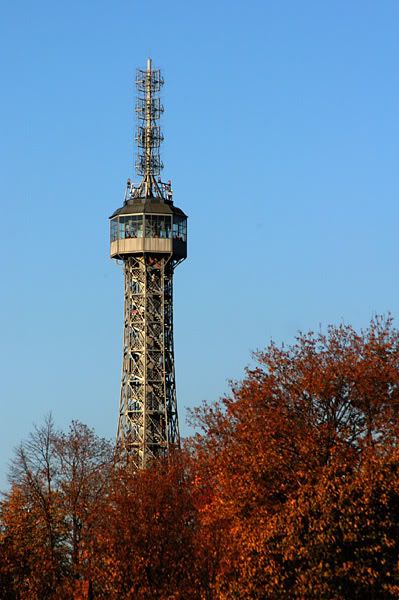 Petrin Lookout Tower. A 1.5 scale reproduction of the Effiel Tower. I've read somewhere that although the tower is much smaller than it's Parisian twin, they're both at the same altitude because Petrin is on top of a hill. It's an awful strain on the legs as we trudged up the steps, but the view at the top was worth it. If you can get over the head-spinning height, the sprawling panoramic view of the entire city is dazzling. The eyes are overloaded with sights, the winding Vltava river, the multitude of spires and turrets, the Castle and much more. On the ground around the tower is a small cafe and gift shop and a hundred yards away is the Hall of Mirrors whichactually works like it's supposed to, crazily. I got to experience being tall!
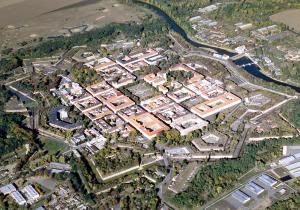 night (I fell asleep in my clothes, on the floor. Uck.) and an early morning dragging our luggage into the coach, we set off for the village of Terezin. There are two sides of it, the village which used to be a Jewish Ghetto and is now a regular town with shops, restaurants and houses, and the fortress which was originally a prison and was used as a concentration camp in WWII. Unlike Auschwitz or Dachau, Terezin was not a typical extermination camp in the usual sense. There were no gas chambers and it was primarily used as stopover for people on their way to other camps in Europe. But, as the guide explained, many people died there. The Nazis didn't have to use gas to kill thousands, they worked people to death, they starved them, they locked them in tiny cells for days upon end without food or water. We saw the single cells (horrible cramped rooms with no windows) and a mass cell where 80 men were kept for weeks. These men were forced to stand upright, because there was no room to sit or lie down. Just to give you an idea, there were about 45 in our tour group, and we were getting clasutrophobic. We saw the workyards, the execution sites and walked through an underground tunnel, half a kilometre long, that was built when the site was just a prison. The whole thing was upsetting, in a numb kind of way. Learning about concentration camps used to upset me greatly when I was little, and actually being inside one was an uncomfortable experience. The Jewish Ghetto was the same, we visited a couple of museums and the crematorium and they were all very depressing. It was a sobering experience but I'm glad I experienced it. A lot of girls were bored, especially the younger ones, which is understandable but I tried to take it all in. It's important to remember this period of history, even if it's not exactly enjoyable. Only by remembering this stuff in the past can prevent us from repeating it in the future.
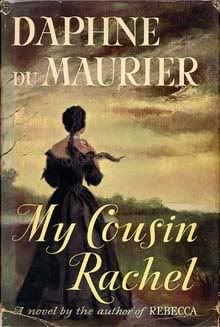 I'll give a quick rundown of the plot. Philip Ashley is a headstrong young man in his early-20s. He grew up in the care and company of his older cousin, Ambrose - a gleefully playful and devoted relative whom the young Philip always admired. They live together in a sort of 19th century bachelor pad and their lifestyle is easy and fun, until Ambrose becomes ill and travels to Europe to regain his health. Philip begins to recieve letters from his cousin, letters describing his health, daily life in Europe and eventually, mentions of a woman always referred to as "my cousin Rachel". It transpires that this woman is a distant relative and Ambrose becomes infatuated with her. The next thing Philip hears is that they have wed and are living together in Italy. Slightly annoyed at this turn of events, Philip manages to carry on in the house by himself - until he begins to recieve letters of a different tone. Ambrose sounds unhappy, but before anything concrete can be determined, the letters stop. Almost a year later, Philip recieves a few letters from his cousin that seem to have been written by a man on the brink of madness. Shortly afterwards, Ambrose dies from a mysterious illness.