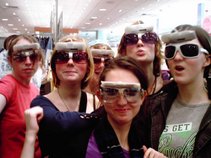
(via Go Fug Yourself)
Saturday, April 7, 2007
Overheard in St. Patrick's Cathedral
Two smartly-dressed women, during the interval of the Good Friday concert.
"Sorry, who's taking the photographs?"
"That would be Stella."
"Riiiight. Just that, well, she's actually taking some while the singers are onstage."
"What?"
"Yes...it's quite bright, the flash."
"I'll...I'm so sorry. I'll go talk to her. Excuse us. Stella? Steeelllaaaaaaaaaaaa!?!"
The programme for the evening was:
Allegri's Miserere
Bach's Ich Habe Genug.
Faure's Cantique de Jean Racine and Requiem.
All pieces were beautiful, but the Bach didn't hold me. It's a cantata in 5 movements, with a bass soloist. It was the only piece I wasn't familiar with and we were sitting to the side, which meant we were away from the soloist and the acoustic seemed to swallow him up. The cold air inside the church was extremely unfavourable to the musicians; the acoustics weren't great on the whole and it also played havoc with the instruments. In the Requiem, which was played last, some of the brass sounded decidedly odd and the violin part in the Sanctus sounded a little out of tune and offputting. It was a minor quibble though; on the whole, it was a fitting end to Good Friday. We're learning the Cantique in choir and hearing it sung live is really impressive, especially when you consider that Fauré was a 20 year old student when he composed it. His Requiem, written not too long after, is such a gorgeous piece of music that I almost want it for my own funeral - if people could sit that long. Apart from the violin in Sanctus, it was a rousing and moving performance. It's hard for go wrong with Fauré, really.
"Sorry, who's taking the photographs?"
"That would be Stella."
"Riiiight. Just that, well, she's actually taking some while the singers are onstage."
"What?"
"Yes...it's quite bright, the flash."
"I'll...I'm so sorry. I'll go talk to her. Excuse us. Stella? Steeelllaaaaaaaaaaaa!?!"
The programme for the evening was:
Allegri's Miserere
Bach's Ich Habe Genug.
Faure's Cantique de Jean Racine and Requiem.
All pieces were beautiful, but the Bach didn't hold me. It's a cantata in 5 movements, with a bass soloist. It was the only piece I wasn't familiar with and we were sitting to the side, which meant we were away from the soloist and the acoustic seemed to swallow him up. The cold air inside the church was extremely unfavourable to the musicians; the acoustics weren't great on the whole and it also played havoc with the instruments. In the Requiem, which was played last, some of the brass sounded decidedly odd and the violin part in the Sanctus sounded a little out of tune and offputting. It was a minor quibble though; on the whole, it was a fitting end to Good Friday. We're learning the Cantique in choir and hearing it sung live is really impressive, especially when you consider that Fauré was a 20 year old student when he composed it. His Requiem, written not too long after, is such a gorgeous piece of music that I almost want it for my own funeral - if people could sit that long. Apart from the violin in Sanctus, it was a rousing and moving performance. It's hard for go wrong with Fauré, really.
Friday, April 6, 2007
Golden City of a Hundred Spires
Well, after a full 13 hours sleep and a pot of strong coffee, I've finally recuperated from my trip to Prague. It was a great 5 days, probably the best foreign school trip I've been on (and most likely, the last). In 1st year I was skiing in Italy, which was a whole school event rather than a choir trip and in 3rd year I was in Paris with the choir. Prague was my favourite for a couple of reasons: I'm a senior now (which means more freedom) and it was also a city that interested me. While Italy is a cool place, it was primarily a ski-trip and we didn't get much of a chance to see the country, other than an excursion to Verona to see the place where Romeo & Juliet was set. (Which, on retrospect, I didn't fully appreciate at the time.) I'd already been to Paris at the time of the choir trip, and although the novelty had by no means worn off, there was no time to do my favourite Parisian stuff (i.e. spend days browsing in Shakespeare & Co., sit on the bank of the Seine reading, go to FNAC and stay hours). But Prague was different in that I had abosolutely no first-hand experience of the city.
This was remedied by our guide for the week, Adita. She was with us every day, morning to night and we learned all about Prague from her. Her English was excellent, but a thick accent and odd turn of phrase meant that some times she was absolutely hilarious.
"I will teach you some words now. Pivo is beer in Czech language. You are not permitted to drink it, probably, but in Prague, beer is very important. We drink a lot of beer. Also, we eat a lot of food. On Christmas, we give the presents a day early because we eat very large meal on Christmas and we don't know if we will be alive next day. Many Prague men are very fat. Actually, when I was going to birth my second child and I was just two weeks away from birth, we meaure my stomach and the stomach of my husband and we did not know who was going to the maternity hospital. He has big stomach. (PAUSE) But he is nice man."
She ended many speechs with the slightly ominous command, "You must survive this." She also talked quite a bit about defenstration (the act of throwing someone out a window). I was always aware of this as a funny, esoteric word, but I never expected to hear it in real context.
Her knowledge of the history of Prague and the Czech Republic was vast and she was more than willing to answer any questions we had about the city or the language. I have to say it's an utterly beautiful city, as is obvious by it's nickname; the Golden City of a Hundred Spires. Everywhere is like a picture book illustration and the whole city seeped in history. From the Habsburg dynasty, through the Nazis and WWII and the subsequent Soviet invasion, history is everywhere in Prague and you can't turn around without bumping into a statue comemerating someone or something.
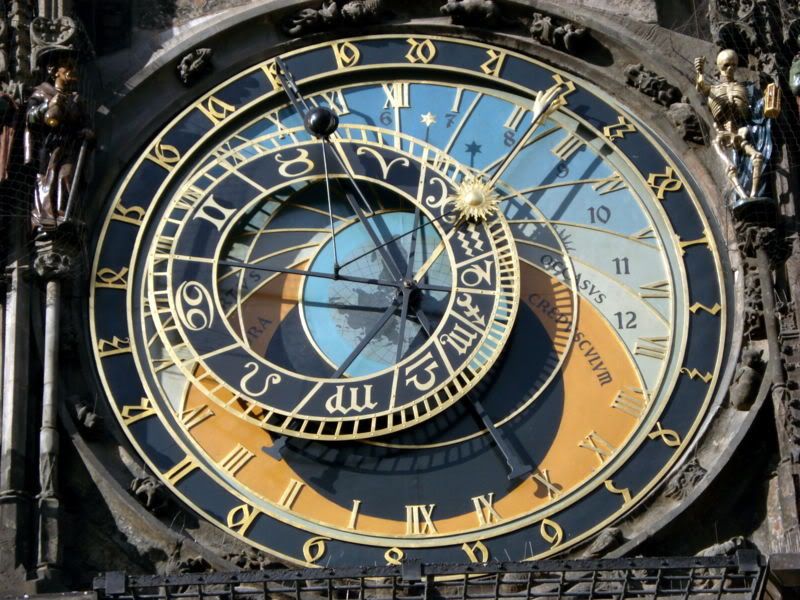
One of the first major touristy sights we saw was the Astronomical Clock. This is situated in Old Town Square and is an impressive sight. Unlike any regular clock you've seen before, the Astronomical Clock counts the months and the position of the sun and moon in the sky. The figures of the 12 apostles appear at one of the windows once every hour and there are also four carved figures on the outside of the clock, representing Death, Jewish, Turkish and Vanity. The whole thing is an impressive jumble; it made sense to architects and astronomers, but to us it just looks like a mass of colour and circles. An interesting mass, mind you.
Adita instructed us to meet at the clock at 2pm, upon whence we witnessed the figures moving. Death starts ringing his bell (strangely fightening, even on a hot, bright afternoon surrounded by tourists) and the figures move jerkily, before the windows clack open and out come the apostles, slowly rotating past. It's all a bit reminiscent of Clockwork, the Philip Pullman book that frightened the life out of me when I was younger.
We also saw Prague Castle, an almost unbelievable place straight out of a fairy-tale. Anyone who's been to DisneyLand, imagine the sculptured turrets of one of the Princess' palaces and you're almost there. We heard the legend of St John who heard the Queen's confession and refused to tell the King what she confessed. He was beaten and tortured and when he still kept quiet, he was hurled off the Charles Bridge. Apparently, as he drowned in the Vltava, five golden stars appeared above his head.
I also got to try out my language skills! When I arrived, all I could say was hello and help me, but now my vocabulary encompasses the following:
hello, hi, help me, watch out, yes, no, thank you, please, beer, wine, where is the ice-cream, good dog.
Useful as hell, I can tell ya.
Other things we did:
Concert/Mass. It was a choir trip, and therefore we had to sing. On Monday evening we sang at a mass in the city centre, which was fine although we had no idea what was going on. Tuesday morning we went to the Mozart museum, situated in an old villa where Mozart used to stay. We got a chance to look around the exhibits and the gardens before singing in the open courtyard outside the museum. It was beautiful; although the sharp morning air forced us to leave our jackets on, the setting was lovely and singing John Rutter's ode to all things beautiful and nature, "For The Beauty of the Earth" with the birds twittering above our heads was an experience I'll never forget. We were all relived when the singing was over though, as it meant we could enjoy the rest of our time as a holiday.
We went to a Black Light Theatre show called Aspects of Alice. It was a mime/music/light/shadow/puppet/video performance thing that was almost as bizare as that sounds. And in the second half there was nudity, which was hilarious as I was sitting in front of the teachers. Half of them were scandalised and the others were snorting with laughter.
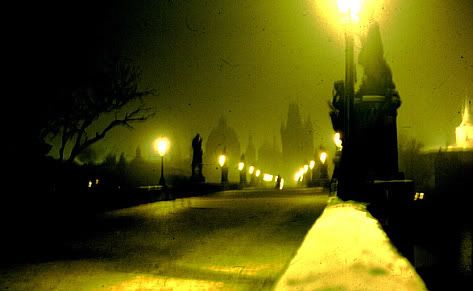
Charles Bridge. We crossed the picturesque bridge on our way to the theatre. It was late evening, the view was just spectacular and the place was aswarm, which explains why I didn't notice the hooded figures until I almost ran into one. There were a group of about twenty men and women dressed in long back cloaks and hoods, kind of resembling Death Eaters or those things in The Village. Their faces were hidden, some by their clothing and others wore skeleton masks. Although the figures weren't doing much, just milling around and leaning on the side of the bridge, people began to get slightly uneasy. This feeling was magnified when one of them walked up to one of the teachers and began to loom over her, walking her backwards and opening his arms wide, pressed up into her face. She just laughed it off and then everyone took pictures of the Death Eaters. "They aren't coming out!" people wailed in horror as they inspected their digital cameras. "You can't see them on the screen!" It was obviously because they didn't show up black in the darkness, but it was thrillingly spooky, in a fun way.
Ice Skating. Yeah, I suck at balance.
Terezin Concentration Camp. This was the hardest thing we did. On Thursday morning, after a late
The only thing I was disapointed about was that I didn't get to visit the Kafka Museum. But I know that there would have only been a small number of the group who would have cared to visit it, and this just gives me an incentive to return to the city again. I did buy a Kafka t-shirt and notebook. As the old saying goes, when in Prague, buy tacky Kafka merchendise.
I left my camera behind, but wasn't too torn up about it. My friends brought enough to stock a Kodak factory and I was afraid of being stuck behind the lens rather than seeing things first-hand and taking it all in. I plan to steal some photos when they inevitably turn up on Bebo within the next few days and will duitifully put them up here.
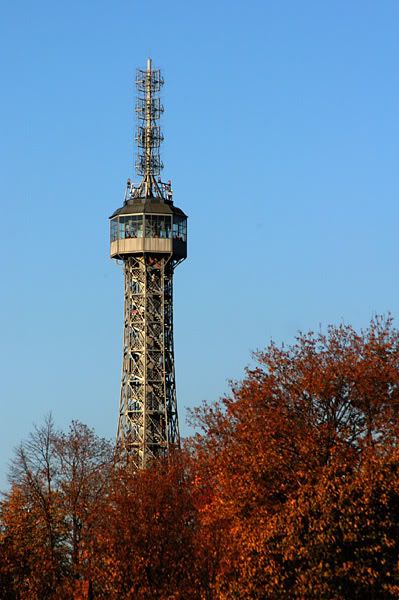
UPDATE: Added some pictures. These are just taken from various websites, I haven't been able to get ahold of photos taken by choir members. Yet.
I'm off to lie on my bed now. Going to see Faure's Requiem in St. Patricks' Cathedral tonights!
Friday, March 30, 2007
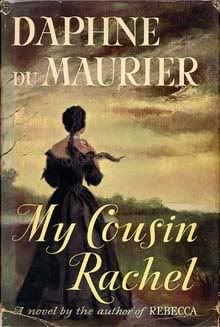
"My Cousin Rachel"
First things first; the episode titles for the 3rd series of Doctor Who (thanks Ann-Marie!)
3: Gridlock
4: Daleks in Manhattan (Part One)
5: Evolution of the Daleks (Part Two)
6: The Lazarus Experiment
7: 42
8: Human Nature (Part One)
9: The Family of Blood (Part Two)
10: Blink
11: Utopia
12: The Sound of Drums (Part One)
13: Last of the Time Lords (Part Two)
Preliminary thoughts:
So don't forget! Doctor Who, BBC, 7pm, tomorrow. Be there - or be a Dalek-y type square.
Now;
"They used to hang men at Four Turnings in the old days. Not any more though..."
Daphne du Maurier doesn't get enough credit. As regards mystery or horror writers, she seems to be left in the dust of the big boys; and when it comes to to talent of crafting a perfectly poised opening sentence, she is almost completely forgotten. It's a shame, because the opening line of My Cousin Rachel is about as perfect as you can get - it's mysterious, elegantly phrased, memorable and becomes significant later on in the story. Along with her famous "Last night I dreamt I went to Manderly again..." in Rebecca, du Maurier has got this art to down to a tee.
I didn't actually mean to start reading this book. It's just that on Monday I found myself sitting in a double free class with no homework, study or book at my disposal. I excused myself to the school's pitifully-stocked library;amid the Boyzone annuals and dusty history tomes I came across this battered Daphne du Maurier paperback and decided it would do to fill my time neatly until the bell rang for home. 80 minutes later I was deeply engrossed in the story, despite myself. I had forgotten how good du Maurier is; when I think of my favourite writers I always seem to leave her out, although I've loved Jamaica Inn, Rebecca and of course, Don't Look Now. She has a knack for creating deceptivly simple stories that chill me right to the bone. In everything I've read by her there's been a moment which has deeply disturbed me, in the best way possible. When I first read Don't Look Now, it was quite late at night and when I reached the ending (that ending...) I actually threw my copy across the room in horror and shock and revulsion. And if a writer can elict that kind of visceral response from me, I know she's a keeper.
I'll give a quick rundown of the plot. Philip Ashley is a headstrong young man in his early-20s. He grew up in the care and company of his older cousin, Ambrose - a gleefully playful and devoted relative whom the young Philip always admired. They live together in a sort of 19th century bachelor pad and their lifestyle is easy and fun, until Ambrose becomes ill and travels to Europe to regain his health. Philip begins to recieve letters from his cousin, letters describing his health, daily life in Europe and eventually, mentions of a woman always referred to as "my cousin Rachel". It transpires that this woman is a distant relative and Ambrose becomes infatuated with her. The next thing Philip hears is that they have wed and are living together in Italy. Slightly annoyed at this turn of events, Philip manages to carry on in the house by himself - until he begins to recieve letters of a different tone. Ambrose sounds unhappy, but before anything concrete can be determined, the letters stop. Almost a year later, Philip recieves a few letters from his cousin that seem to have been written by a man on the brink of madness. Shortly afterwards, Ambrose dies from a mysterious illness.
When his widow, the mysterious Rachel, arrives in Cornwall, she is quite unlike the woman Philip has been imagining,hating and privatey blaming for the death of his cousin all this time. She moves into his house, and Philip soon becomes infatuated with her...
The ending is typically ambiguous, which is ultimatly more satisfying than a clear-cut answer would be. The narrative seems simple, at times I was feeling all the emotions that Philip was, but at others I was this close to yelling at the page "No, you fool!" At times I really wanted to shake him, which added to the tension simmering all the way through this short novel.
In short: Gripping, intriguing and with an ending that will leave you trying to puzzle it all out, My Cousin Rachel is an oft-forgotten masterpiece by a talented (and neglected) writer.
====
Prague on Sunday! Kafka-land, here I come!
Preliminary thoughts:
- Only 13 episodes?!? Ah, crap.
- Episode Two had better not be a sub-Da Vinci Code thing. I'm warning ye, do not do that to the Bard! *shakes fist*
- Could Episode Seven be a Douglas Adams reference? Wow, I'd love if Marvin the Paranoid Android had a guest spot.
- And then that last one. "Last of the Time Lords?" Sounds a wee bit ominous. I guess the fact that David Tennant has signed up for series 4 dispells any worries I have in that respect, anyhow.
So don't forget! Doctor Who, BBC, 7pm, tomorrow. Be there - or be a Dalek-y type square.
Now;
My Cousin Rachel (Daphne du Maurier)
"They used to hang men at Four Turnings in the old days. Not any more though..."
Daphne du Maurier doesn't get enough credit. As regards mystery or horror writers, she seems to be left in the dust of the big boys; and when it comes to to talent of crafting a perfectly poised opening sentence, she is almost completely forgotten. It's a shame, because the opening line of My Cousin Rachel is about as perfect as you can get - it's mysterious, elegantly phrased, memorable and becomes significant later on in the story. Along with her famous "Last night I dreamt I went to Manderly again..." in Rebecca, du Maurier has got this art to down to a tee.
I didn't actually mean to start reading this book. It's just that on Monday I found myself sitting in a double free class with no homework, study or book at my disposal. I excused myself to the school's pitifully-stocked library;amid the Boyzone annuals and dusty history tomes I came across this battered Daphne du Maurier paperback and decided it would do to fill my time neatly until the bell rang for home. 80 minutes later I was deeply engrossed in the story, despite myself. I had forgotten how good du Maurier is; when I think of my favourite writers I always seem to leave her out, although I've loved Jamaica Inn, Rebecca and of course, Don't Look Now. She has a knack for creating deceptivly simple stories that chill me right to the bone. In everything I've read by her there's been a moment which has deeply disturbed me, in the best way possible. When I first read Don't Look Now, it was quite late at night and when I reached the ending (that ending...) I actually threw my copy across the room in horror and shock and revulsion. And if a writer can elict that kind of visceral response from me, I know she's a keeper.
When his widow, the mysterious Rachel, arrives in Cornwall, she is quite unlike the woman Philip has been imagining,hating and privatey blaming for the death of his cousin all this time. She moves into his house, and Philip soon becomes infatuated with her...
The ending is typically ambiguous, which is ultimatly more satisfying than a clear-cut answer would be. The narrative seems simple, at times I was feeling all the emotions that Philip was, but at others I was this close to yelling at the page "No, you fool!" At times I really wanted to shake him, which added to the tension simmering all the way through this short novel.
In short: Gripping, intriguing and with an ending that will leave you trying to puzzle it all out, My Cousin Rachel is an oft-forgotten masterpiece by a talented (and neglected) writer.
====
Prague on Sunday! Kafka-land, here I come!
Wednesday, March 28, 2007
Writers I adore: David Sedaris
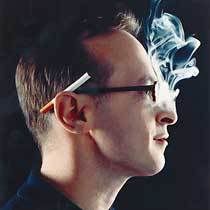
One Saturday, while browsing through second-hand bookshops, I came across a well-thumbed, slightly bent copy of David Sedaris' short story collection, Me Talk Pretty One Day. At the low, low price of $3.50 (how does one get a euro sign to work?), I just had to buy it. I'd already read it a couple of times, but I needed my own copy.
Later, while on the bus home, I took the risk of getting travel-sick and began to read a couple of the stories. Midway through Jesus Saves, I had to stop. Not because I was about to get sick, but because my loud giggles were disturbing the people around me. I closed the book hurriedly and shoved it in my bag. Too late, the words were stuck in my brain and I couldn't help myself. Shoulder quivering with the force of trying to hold back the laughter, eyes brimming over with mirthful tears, I stared out of the window and made myself think of Sad Things.
Okay, I'll admit that it's quite easy to make me laugh. My sister once threatened to disown me when we went to see Flushed Away (that movie was brilliant on about ten different levels) I was laughing so hard. But Sedaris is someone special. No matter how many times I read his writing, no matter if I know the stories almost by heart, I still find them amazingly amusing.
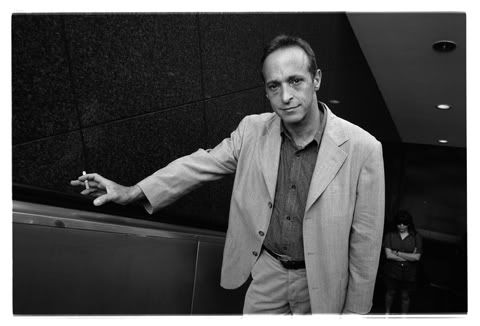
David Sedaris is an American humourist now living in France. He's gay, comes from a large family and once worked as an elf in a department store. His account of this job, as told in the story The SantaLand Diaries, is one of my favourite short stories of all time. Yep, a non-fiction comedy piece is up there with Lorrie Moore, Kafka and the rest of 'em. Listen to the story here - Sedaris also reads his work on American radio. Once you listen to him reading, his voice will never leave your head. In a good way, I mean.
Some of his best work comes from his struggles with the French language. When he first moved to France, the only word he knew was "bottleneck", which, as you can imagine, isn't the most useful phrase to have at your disposal. Fortunately, after a torturous series of French lessons ("It was mid-October when the teacher singled me out saying 'Every day spent with you is like having a cesarean section'. And it struck me, for the first time since arriving in France, I could understand every word that someone was saying") he became quite fluent. He puts his life into his work, we know his family, his childhood, his lovelife and his little quirks and foibles. Over the years that I've read him (I first came across his writing in Paris, around 2004) I've grown to love his work like an old friend. His books sit on my shelves, waiting for those days when I feel miserable and need someone to make me smile again.
But don't take my word on it. Check him out for yourselves;
In The Waiting Room
Memento Mori
Interview with David Sedaris
=======
Other links of interest:
I wouldn't wear this shirt, but it sure does make me laugh.
Emma over at All About My Movies is holding a blogathon this July on the subject of "Performances that Changed Your Life". Sign up now!
And don't forgot, series 3 of Doctor Who is beginning this Saturday!
Sunday, March 25, 2007
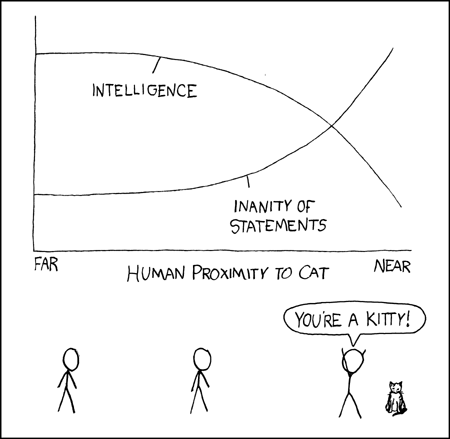
Here kitty kitty kitty!
I just found a great online comic strip: XKCD - A Webcomic of romance, sarcasm, math, and language.
It's unbelievably geeky (woo! check out that oxford comma in the tagline!) and brilliant.

It's unbelievably geeky (woo! check out that oxford comma in the tagline!) and brilliant.
Saturday, March 24, 2007
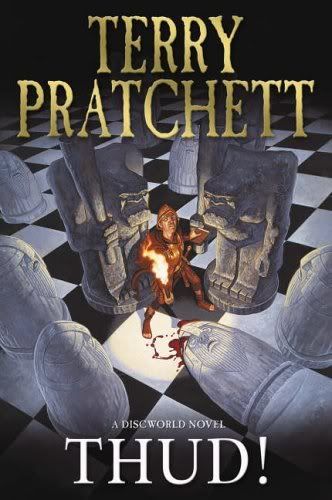
"Thud!"
My enjoyment for Terry Pratchett books are one of the many things in my life that tip me over onto the Geek side of the scales. Ever since I read the Bromeliad trilogy when I was quite young, followed quickly by the Johnny books and from then on progressed on to the "adult" Discworld novels, I've been a Pratchett fan-girl. (Is there are correct term for one of these? Star Trek fans are Trekkies. Tori Amos fans are Ears With Feet. Discworld fans need a moniker!)
"Thud!" is the latest in the series and I believe the 30th book. I'll confess, I haven't read all 28 others. I know which sub-sects I enjoy (Death, the Witches, the Watch) and those I don't ( the latest kiddy ones like The Wee Free Men and the Wizards, while fun, aren't my favourites) and I'm quite happy to stick with the ones I like. I haven't read a new Discworld in ages and if my mam hadn't handed me this one the last time we were in the library, it's doubtful whether I've had read it at all. Luckily, she did.
Pratchett has an inate gift for combining subtle social commentary with bizarre and often stomach-clenchingly funny humour. Over the decades, he's built up a wealth of characters and backstory; a richness that allows him to jolt back and forth between intertwining storylines and to let him pile on the inside jokes. A new fan of the series would definitely have a major problem unravelling the intricate web of characters presented in "Thud!", but for a seasoned visitor to Ankh-Morpork, it's like greeting a group of old friends again.
Commander Sam Vimes is the novel's main player and we get an indepth look into the man's psyche. Juggling his (considerable) duties as leader of the City Watch and his new life as a devoted husband and father (the scenes in which Vimes deals with Young Sam are some of the most touching that Pratchett has ever penned), Vimes is a severly stressed man. And his stress is about to build, as it's fast approaching the anniversary of Koom Valley - a legendary battle where a group of dwarves ambushed a group of trolls (or was it the other way around?) and the two species are beginning to become hostile towards each other. When a dwarf is found murdered with a troll's club beside the corpse, the threat of another battle is iminent and Vimes must keep the two sides away from each other, solve the murder, control his Watch and make it home every night at 6 to read "Where's My Cow?" to Young Sam. This is probably the first time we get such a layered look at Vimes and he is the perfect man to build a storyline around; tough, realistic, kind-hearted and just the littlest bit insane.
However, Vimes isn't the only character who has a role to play. The other members of the Watch appear regularly, from old favourites like the bashful six-foot dwarf Captain Carrot and the pimply subhuman Corporal Nobby Nobbs, to the newer arrivals such as Angua the werewolf and Sally the vampire. One of my personal favourites, the city Patrician, Vetinari features and there's a short cameo from my numero uno, Death himself. There's even a quick reference to Foul Ole Ron, the very mention of whom is sure to elict a giggle.
Pratchett is not shy at taking a dig at Earth. Discworld may be floating on the back of an turtle being carried by four elephants, but the two worlds share many details. Fundamentalism, positive discrimination, war, stripclubs and The Da Vinci Code are just some of the topics that Pratchett aims his pen at; and every one is a hit.
"Thud!" takes a good while to get going. When I began reading, it was with a definate lack of interest and the first 100 pages seemed to drag. However, as the plot began to get going and the jokes came thick and fast, I became more and more engrossed in it. The last 150 pages I devoured in a happy rush and the whole thing ends very satisfactorily.
I doubt I'll ever enjoy a Discworld novel the way I enjoyed "Mort" when I was 12, but "Thud!" proves to me that Pratchett still has the magic touch.
Subscribe to:
Posts (Atom)