Monday, October 8, 2007

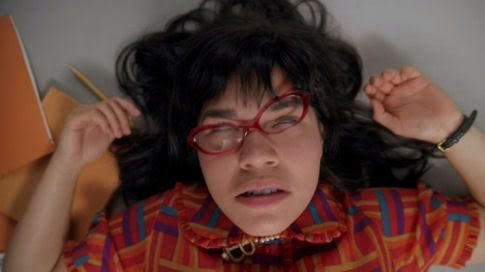
Ugly Betty Season Two, Episode One

Ugly Betty sneaked up on me last year to become my favourite new show of 2006. The first couple of episodes did nothing for me, the characters were too broadly drawn, the cartoonish style grating, the humour too weak. It's premiere collided unfavourably with the hype surrounding The Devil Wears Prada and I initially dismissed it as another well-intentioned, but unfunny satire of the fashion industry. The very fact that I've been eagerly awaiting this season premiere all summer should alert you to two facts; that I'm as fickle as a pickle and that you shouldn't judge a series by it's season opening (unless it's that rare beast, a first episode that's simultaneously enormously entertaining and indictitive of the series to follow, step forward the pilot episodes of Arrested Development and The West Wing). That's why I'm not too worried that the first Ugly Betty episode of the new season wasn't quite up to the usual standard - things can only get better.

As can only be expected, "How Betty Got Her Grieve Back" primarily deals with bringing us up to date on the characters. Betty is trying to forget about Henry by taking on an even greater workload, resulting in her becoming super-stressed and even getting, um, high blood pressure. What is it with this show and stupid medical-related problems? Ignacio's heart condition was boring enough - if I wanted hospital action I'd be watching Grey's Anatomy. We discover that Bradford is Amanda's father which I think is supposed to be a major plot point, but which didn't elicit an "Oh my God!" such as an "Oh...yeah. Duh?" response. Bradford really bores me, I wish the guy would get a facial expression or two.
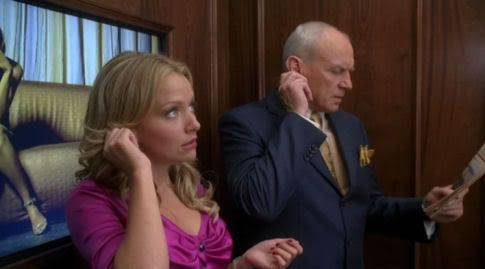
The Awesome Claire Meade is living with prison break-out buddy Yoga in what looks like a beach house of some description; Daniel is recovering in hospital from the car-crash that has left his sister Alexis in a coma (!), Wilhemina is still scheming to get her hands on Mode Magazine, Marc is...doing not much and Christina is still Scotish. I wonder if they'll develop her "I left a husband back in Scotland" storyline; I kind of hope not, unless they draft someone amazing in to play Mr McKinney. Somebody, say, Scottish and dark and...Timelordesque?

As usual, Mark and Amanda provide the giggles. Even fairly clichéd phrases are laden with extra humour and snark when they drip from this pair's laconic tongues.
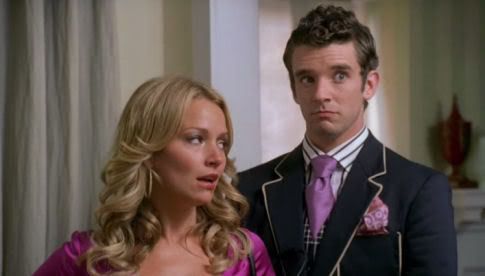

Marc:
So, this is where you grew up?
Amanda:
This is it. The house of lies. [shouting upstairs] Mother! If that is your real name...

We also get a nice, if slightly awkward looking, Mark dressed up as Wilhemina. His Wili-outfit looks suspiciously like his Middle-Ages outfit from Secretary's Day. One tacky wig fits all, I guess.

Alexis wakes up from her coma, feeling thirsty. The twist? She wonders why her brother is calling her Alexis. "It's me, Alex" she croaks. I've never been in a coma, but I would hope that when I awoke I'd be able to tell what sex I was. Maybe that's just wishful thinking...

Finally, the crux of the episode - Santos' departure. The episode tries to lull us into a false sense of security by having Santos "alive" throughout the entire episode but c'mon people, after that season ending how could they leave him alive? It was slightly manipulative to have Hilda be with Santos for the entire episode just to reveal the truth at the end, but I admit I wallowed in it. When Betty opened the door to the darkened room with Hilda hunched alone in her bed...yep, I cried.
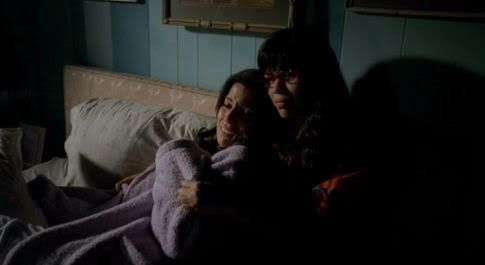
But, no fear because happiness is (hopefully) soon at hand - the glorious return of Senor Grubstick to the Big Apple! Yahoo!
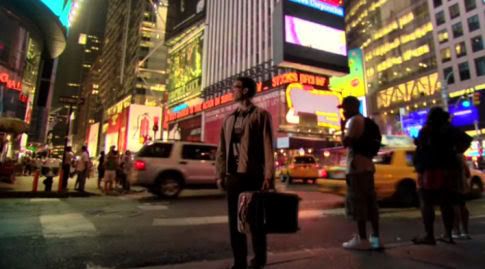
Let's hope Charlie's gone for good. I like Jayma Mays who plays her but the character was such an unnerving mix of cloying sweetness and pyschopathism that she was impossible to like (Mays similar but superior character, also named Charlie, on Heroes was cruelly murdered in her first episode - this actress just can't get a break).

One question - what the hell is up with the timeline of this episode? I only watched it once, so maybe somebody mentioned how much time has passed since the last episode, but if they did I missed it and so am a little confused. Daniel is recovering in hospital but is still fairly beat up (and still poppin' those pills, good old Danny) and Alexis is in firmly in a coma which would lead to me believe only a shortish time has passed; Justin's at summer-camp and seeming quite perky despite his obvious cause for being miserable (having your dad bumped off just as you two were getting along, him showing you how to snap your fingers and all, must be a bit of a downer, no?) so I'm inclined to think a decent amount of time has passed. Conflicting thoughts! Agh. This show should not require brain power. Plus, how long did it take Amanda to confront her parents about their true identity?

Overall, it was a decent episode with some laughs, some tears and, yes, a couple of cringe-worthy moments. There was no Wowzer moments, but that can hardly be expected in a expositionary episode.

Best Line:

Claire Meade: "I’ll be dressed as a nun ... or a cat. I haven't decided yet."

(Have I mentioned that Claire Meade is awesome? That punch she administrated to Wili was dead on, much better than the lame one Bree gave to to Orson's ex-wife that I can't remember what she was called in the last season of Desperate Housewives.)

Thursday, October 4, 2007

In Rainbows


It came out of nowhere. Four days ago, on Monday, a short announcement appeared on Radiohead's blog, Dead Air Space. Seemingly apropos of nothing, it signalled the arrival of a new Radiohead album in the most incongruous way possible.


Hello everyone.
Well, the new album is finished, and it's coming out in 10 days;

We've called it
In Rainbows.
Love from us all.

Jonny


This low-key announcement is at odds with the buzz this is sure to generate. Radiohead's last album, Hail To The Thief, was released in 2003 - it's been a long wait for Radiohead fans. This new album has been supposedly knocking around for years, with the band looking for a label to release it on. Finally they seem to have struck on a solution - to distribute the album themselves. Therefore, In Dreams probably won't be available in the shops.

Fans can get ahold of the album in two ways:

1. Order a digital copy, paying whatever you want and recieving a link to a downloadable file on Wednesday 10th October.

2. Order a "discbox". From the site itself:

THIS CONSISTS OF THE NEW ALBUM, IN RAINBOWS, ON CD
AND ON 2 X 12 INCH HEAVYWEIGHT VINYL RECORDS.
A SECOND, ENHANCED CD CONTAINS MORE NEW SONGS, ALONG WITH DIGITAL PHOTOGRAPHS AND ARTWORK.
THE DISCBOX ALSO INCLUDES ARTWORK AND LYRIC BOOKLETS.
ALL ARE ENCASED IN A HARDBACK BOOK AND SLIPCASE.

THE ALBUM DOWNLOAD AUTOMATICALLY COMES WITH THIS PACK.
YOU CAN DOWNLOAD THE FILE DIGITALLY FROM THE 10TH OCTOBER 2007.

DISCBOXES ARE BEING MADE TO ORDER AND ARE PRICED AT £40.00 INCLUDING POSTAGE.
SHIPPING WILL BEGIN ON OR BEFORE 3RD DECEMBER 2007.


I'm of two minds about this. Part of me is slightly put out by the fact that the album won't be available in the shops. There's a certain thrill in heading into town on a designated day to pick up a new album from one of your favourite bands. I distinctly remember waiting outside Tower Records in town the day Hail To The Thief was released, totally hyped about bringing it home and listening. It added a physical element to the purchase. The fact that my first listen of this will be online saddens me somewhat. Then again, part of me is totally dumbstricken in a good way, awed at this marketing tool. In allowing fans to purchase a totally free download of the album, Radiohead are almost sure of losing money. Say what you will about their music or their politics, but you have to hand it to them; this sure is a novel idea.

Which leads me onto my own confession: I opted to pay nothing for the download. My reasons for this are manifold:

1. I've supported Radiohead for roughly 6 years now. I've bought all their albums, several EPs, a couple of shirts and I've seen them live twice. It's fair to say I've spent a considerable amount of money on them.
2. The very fact that the option to pay nothing exists means we don't have to feel guilty. Radiohead expect some people to pay nothing.
3. There is no guarantee that I will actually enjoy this album. Okay, the chances that I won't are slim, but they do exist.
4. The discbox. I've yet to place an order and I pretend to be deliberating over it in my head but if I'm being honest I know I will end up shelling out the 57 euro (or whatever it is) for it.


Even though I would have been dizzy with excitement if this happened two years ago, I'm still curious to see what this will turn out like. Expect a full review sometime next week.

Wednesday, October 3, 2007

Ha...ha...happ...happy....happy b....happy birth...


Back in January I hosted a birthday bash for Phillip Glass, but today is infinitely more special as today is the birthday of my personal favourite modern composer. October 3rd, 2007 is when Steve Reich turns 71! Reich is a personal hero of mine, ever since I went to see some of his work played in the National Concert Hall last year. Here's what I thought of that performance (bear in mind this was written just after the concert and I was still on a high, so please excuse the hyperbole)

Ladies & Gentlemen, may I please introduce one of the most influential musicians of our time.

Mr Steve Reich.

This weekend just passed marked the 3rd annual Living Music Festival, sponsored by RTE. A three day festival encompassing performances, interviews and other events all based around the theme of contemporary classical music. This year, along with performances of Phillip Glass, Arvo Paart, John Adams and others of the genre, a lot of emphasis was based on Steve Reich. Being his 70th birthday year, RTE took the opportunity to dedicate the entire festival to him. There were concerts, a seminar, a live interview and a “marathon concert” day.

On Sunday 19th February, I along with my dad, was going to hear two Reich pieces preformed live by Ensemble Modern and Synergy Vocals. Excited? What do you think?

We arrived at the National Concert Hall at about 19:00 to collect our tickets. Milling about in the foyer I got a chance to crowd-watch. They were a diverse group; middle aged couples with opera spectacles, young men in Moog t-shirts, new-age hippies, the very elderly and the relatively young. At about 19:40 the doors were opened and we were let in to the hall. No seats were reserved so we could choose where we sat. Now, I’ve been at the NCH before a number of times and in my experience, the best place to sit is up on the balcony overlooking the musicians to their left. From this vantage point you can see every member of the orchestra and exactly what they’re doing. It’s also the closest you can get to the stage. We took our seats and waited patiently. On the stage there were a number of chairs, four grand pianos and a double bass leaning on its side. There was a funny little incident when a youngish guy in a crumpled orange shirt tried to take a seat a few places away from where I was. An usherette promptly told him he wasn’t allowed to sit there. The man protested that he was part of the orchestra, but she wasn’t having any of it and he was ejected.

The musicians came on shortly after that, to great applause. I was half hoping Reich would conduct, but to my slight disappointment the conductor was female. (Sian Edwards, apparently.) The first piece they played was called “Variations (You Are)”. This piece uses 2 flutes, an oboe, an English horn, 3 b-flat clarinets, 4 pianos, 2 marimbas, 2 vibraphones, 3 violins, a double bass, a cello and 6 voices (3 soprano, 2 tenors, 1 alto). It lasts about 26 minutes. It was very interesting to watch as well as listen to, looking at all the different musicians. You could see the different personalities of them, like one of the pianists who was doing most of the playing was very intense. He would finish every chord sequence with an extravegent flourish of his hands and a nod to nobody in particular. The first violinist on the other hand was extremely relaxed and kept grinning at the cellist. One of the pianists looked like Truman Capote and a soprano was the image of Cheryl from Curb Your Enthusiasm!

When they finished and I was clapping away, my dad nudged me to alert my attention to something at the back of the hall. There, in the soundbooth was an elderly man in a baseball cap, standing up and cheering loudly. He was giving thumbs up and blowing kisses to the musicians on the stage. Steve Reich was in the building.

This was the interval and I went to stretch my legs and get a drink. As I was sipping my coke I was thinking about the next piece I was going to hear, the one I really came for, “Music for 18 Musicians”. I couldn’t wait, but I was also nervous. What if it wasn’t enjoyable, what if it didn’t transfer live, what if, what it? We returned to our seats shortly and noticed that the instruments had changed. I’m not taking about shifting a few cellos, the four grand pianos had completely changed position and there was the addition of a metallophone (a vibraphone without a motor) and a xylophone. I also noticed the lack of a conductor’s platform.

From where I was sitting I could clearly view one of the side doors through which the musicians would enter. A small group of them were huddled in the doorway, giggling and nudging each other. They seemed unsure of when to go onstage and kept jostling one other and joking around. At one point they seemed to be communicating with the musicians presumably huddled in the doorway opposite, underneath my seat. It was funny seeing these classically trained musicians acting like school kids. At one point the violinist gave the “wanker” sign to another musician, then burst out laughing. Finally, they decided to enter.The crowd cheered like mad.

“Music for 18 Musicians” is Reich’s seminal work, written between 1974 and 1976. Based on an 11 chord cycle, each individual chord is expanded into a longer piece, which finally returns to the original cycle to finish. Contrary to what the title implies, more than 18 musicians are often needed, as there is a lot of doubling-up required. At this performance there were 19 musicians on the stage. Not all of them were playing all the way through and at certain points people would swap their instruments, a tricky manoeuvre seeing as a continous sound flow was required. One of the musicians was, I was pleased to note, Mr Orange Shirt from before.

Without a conductor to set them off, the musicians had to just give each other a quick nod to start them. At once you’re plunged into this rhythmic, pulsating hum of a sound. In a word, magnificent. Hypnotic, soothing but at times uneasy. The actual musicians were fabulous, moving around the stage, playing various instruments, smiling and laughing at each other and never once loosing their place. At some points you’d hear a noise and it’d take a few minutes for you to figure out what instrument was possibly producing that sound. It lasts about 55 minutes, but that flew by incredibly quickly. It doesn’t end on any great crescendo or anything, so when they suddenly stopped playing there was a sort of bewildered silence. Nobody knew whether to clap or not. Suddenly, a deep, loud, clear voice said “Bravo.” At this, Reich’s helpful instruction that it was indeed over, the place went mental. A fervour unlike anything I’ve seen at a classical concert swept the audience off their feet and into a standing ovation as the man himself made his way up onto the stage. He didn’t say anything, only hugged every musician on the stage and smiled sheepishly at the audience. At this point he was about 3 feet below me. I wanted to yell, “Hey Steve!” or something, but thought better of it. I should have though, damn! After taking a few bows and with a final wave, he left.

It was fabulous, all in all. One of the best concerts I’ve been to in my life.

Part of my 17th birthday present was the Steve Reich boxset, Phases which includes all his major works, from Music For 18 Musicians, Different Trains and Come Out. I'll be listening to some of it before I drop off to sleep tonight, that's for sure. Last year when he turned 70, online music journal Pitchfork hosted a lengthy interview with him, which you can read here. I love reading interviews with Reich, he always seems to be completely down-to-earth and refreshingly unpretentious. Take, for example, his take on whether people need to understand the theory behind his work in order to enjoy it:
"I don't care how much people understand what it is that I'm doing, except if they're players in my ensemble or other ensembles [Laughs]. I just want people to be moved by the music. If you're not moved by the music, then everything else falls away. You're not interested in the text, you're not interested in how it was done, and you're not interested in interviewing the composer and all the rest of it. We're speaking together because you found something interesting that moved you emotionally, is my guess. Or we wouldn't be having this conversation. It's the part of music that's the hardest to talk about, and I don't spend much time talking about it. But it is the bottom line."


Finally, here's a quick video of Reich talking about his music and ethos, from earlier this year. Apparently he won the Polaris Music Prize? Who knew?


Happy birthday, Reich-man!

Sunday, September 30, 2007

Michael Clayton (2007) Tony Gilroy


The summer film season is, by it’s very nature, a distracting force. Just remember our summer just gone; a veritable explosion of superheroes, car chases and giant robots. As we slipped into Autumn there came a handful of comedies headed by Seth Rogen, superficially different than the summer blockbusters but ultimately serving the same purpose, distracting people (in our case, a welcome diversion from the non-stop rain). There’s absolutely nothing wrong with setting out to make a film with the primary goal of entertaining people, but sometimes it’s more satisfying to make a film with something to chew on, a little moral ambiguity to get the brain cells churning. So, as the days get shorter and I get back into the routine of study, the cinema offerings get more serious, more literary, more intelligent. Basically, I’m in cinema heaven with the series of political thrillers and serious dramas like Breach, Rendition, A Mighty Heart and Michael Clayton either currently showing or on their way to the cinema.

Michael Clayton is the latest George Clooney vehicle showcasing his intelligence rather than his looks. It’s something I like about Clooney, that even in his most serious political roles he never seems preachy or even as if he’s grabbing for awards. He has a point to make and does so affably, it almost seems as if he isn’t really acting. In this respect, he’s the closest thing we have to a Cary Grant, somebody who just enters a film with enough self-confidence and charm to just be himself. As the eponymous character, a shady man who works as a “fixer” for a law firm, we never really get into the heart of his character, to discover what makes him tick. Personally, I was never quite sure what to make of him. In another setting this could be a problem, but in this case it suits the film perfectly, dealing as it does with lies and obsfucation.

Although Clooney is the film’s biggest sell, Tom Wilkinson delivers a standout performance as a corporate lawyer. His current client, a sinister multinational called UNorth, have murdered hundreds of farmers with a carcinogenic weed killer. Wilkinson eventually goes crazy and turns his back on his professiona duties after neglecting to take his manic-depression medication, a discomforting downward spiral of insanity. Part of Clooney’s job is convincing Wilkinson that his change of heart is a result of the resulting chemical imbalance, but to the viewer there is no doubt that it is the unbelievable guilt of compromising his morals day-in, day-out that has triggered the madness. The film’s best scene occurs with Wilkison, alone and raving in his apartment, playing UNorth’s advertising spot on repeat, the comforting words and images of small, multicultural children familiar to anyone who has ever winced at the friendly posturing of big businesses. The high-tech audio-visual equipment he uses have all been paid for with the blood of innocents, yet even this chilling scene never reaches the tense heights it could achieve. I have a feeling this is a deliberate move on the part of the director, the whole film is coated in a very slick, corporate feel which furthers the subject matter.

Bolstered by a fine supporting cast and a dense script, Michael Clayton is a head scratching treat. It won’t be for everyone, there’s little flashy or fun, and a quick glance on the IMDB boards show that many people consider it boring, but I thoroughly enjoyed it.

Wednesday, September 19, 2007

Guess what day it is?


International Talk Like A Pirate Day!

Seeing how Pirates are the second most overrated novelty profession (only just overtaken by Ninjas) and how Johnny Depp bastardized the once shebang with those dreadful films, I refuse to participate. Just look at that gurning idiot up above! Would you really want to base your entire vernacular on him? Of course not! Instead, I propose to create International Talk Like a Tax Auditor Day!


Or how about, International Talk Like a Disgraced Former Taoiseach Day!


Or if you really want to push the boat out, International Talk Like Penn Day!

Happy Wednesday, y'all.

Saturday, September 15, 2007

It's Deborah, not Debbie

So, today I met Debbie Harry, or as she now calls herself, Deborah Harry. Or as millions of people around the globe know her, Blondie. Y'know. Her:

Well, nowadays she looks more like this:

She was in HMV Grafton Street for her first ever European signing. Now, I'm really happy she decided to bestow this honour upon Ireland, but she seriously needs to fire her PR company. Why any popstar of her magnitude would chose Dublin for her first European signing is beyond me; but I'm not exactly complaining. Quentin Tarantino was in HMV last night too. It would have been awesome to queue up to see him, shake his hand and say with a big grin, "Hey, Quentin? You're a cunt."

I ended up buying a copy of her new album, Necessary Evil. Which isn't great, but not as over-produced as I had expected. It's no Mantaray, though.

This is basically our conversation (we were in the first ten people to get stuff signed)

Me: Hi. How's it going? Eh, make it out to Catherine please.
DH: That with a C or a K?
Me: That's a C.
DH: Ah. That's my mother's name, Catherine.
Me: Yeah? It's a good name.
DH: It is, yeah. There you go.
Me: Thanks. Okay, cheers, bye!
DH: See ya.

Riveting stuff. She was cool, but very aloof. I didn't have a camera with me - curses.

Sunday, September 9, 2007

Watching Taxi Driver; Magnified.

I've finally seen Martin Scorcese's Taxi Driver on the big screen. It was a markedly different experience from any other previous time I've watch it; the very first time I viewed Taxi Driver was at 3am during a Christmas break, hunched over the tiny television in my bedroom. The sound was turned down low so my parents wouldn't hear and I had to strain to catch all the dialogue. Despite these setbacks, the film still affected me and I couldn't sleep afterwards. This afternoon I went to see a screening of it in the Irish Film Institute. Watching it on a full-sized cinema screen, with Bernard Herrman's exquisite score surrounding me, every grainy night-scene blown up to gigantic proportions, is undoubtedly one of my best film experiences yet.
I can't help being envious of people who were going to the cinema in 1976, when Taxi Driver was originally released. It isn't until you see it in the cinema that you fully appreciate the force of it, the seediness, the beauty. It's a powerful piece of work; what must it have been like to go to the cinema on a Friday night in the 70s, coming to this film with no preconceptions? No idea if it would be any good, no anticipating of the "You talkin' to me?", no prior knowledge of what you were about to see? The violence and racism that sidle around the screen are even mre disquieting, the dreamlike quality magnified, the score is like a drug, drawing you in with the mixture of beauty and seediness that is the main dichotomy expressed in the film.

As I sat there in the screening room, an elderly couple to my left and a young guy in his 20s who kept taking his glasses on and off to my right, I felt a shiver of excitement ripple through the whole audience as the lights dimmed and the Columbia logo flickered onto the screen. There were no ads, no trailers and none of those rating's cards. The film simply started to play; one click and we had started, a giant puff of yellowing smoke from which emerges the taxi cab, set to Herrman's score. I got to thinking about Bernard Herrmann, how I had never really connected the man who scored this with the composer of Citizen Kane, Psycho and, perhaps my favourite music of his, the sweeping romanticism of Now, Voyager. I didn't have long to ruminate on him for long though, as the film started in earnest and I was pulled along in the tide. The cinematography, impressive enough when you're dog tired and straining to see a miniscule screen, was breathtaking when blown up. The film was grainy and flickery at times, but who cared? It only served to further the intense atmosphere.
As well as the technical and visceral aspects of seeing Taxi Driver in this way, much has to be said on the humour in this film. It's not exactly a comedy, but Travis' fumbling attempts to date Betsy are sweetly amusing and the audience responded wonderfully. The biggest laugh in the film came when Travis is buying the guns and the guy who sells them to him keeps offering more guns, more drugs "Crystal meth. I can get ya crystal meth," and finally, ludicrously, offering him a Cadillac. It felt great, to laugh along with 60 other people, at this masterpiece.

If anyone's interested in seeing Taxi Driver, whether on a repeat viewing or as a first-timer, I would strongly urge them to see it on a big screen if at all possible. As cinema goes, it's hard to beat.