“The first rule of Fight Club is - you do not talk about Fight Club. The second rule of Fight Club is - you DO NOT talk about Fight Club.”
 How many people have broken the first two rules of Fight Club? How many journalists, reviewers, bloggers, slackers, deep-thinkers, ordinary folks exiting the cinema and angry moral types who write into their local newspaper complaining about screen violence have deeply angered Tyler Durden by breaking his fundamental law, this Tyler Durden who is already spinning with indignant fury at the rage of his generation? Don’t worry people, Tyler Durden doesn’t exist.
Or does he?
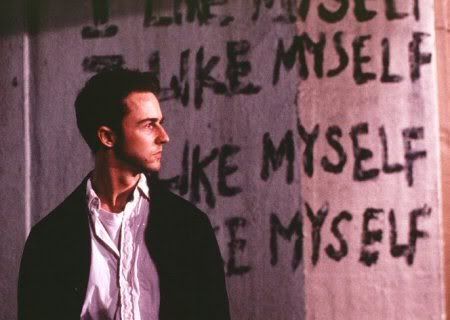
“Fight Club” is the story of one man, technically a nameless guy but we’ll call him Jack for the sake of this. He’s an insomniac, a cynical yuppie who’s narration is the common thread throughout the film. On a mind-numbing business trip, Jack ecounters a man named Tyler Durden, played by Brad Pitt in his rippling muscular glory. Tyler is cool, hard and funny and Jack has to move in with him due to a bizzare turn of fate. They become fast friends and soon begin to adapt to a new way of life, rejecting any notions of what it means to be a “man” in the 20th century and reverting to an older, primal urge; the urge to beat the shit out of others. When they found the titular Fight Club, a chain of events starts up and we are hurtled along until the inevitable catastrophe, in which Jack learns something very peculiar about himself.
There has been so much written about “Fight Club”, the darkly-comic thriller starring Edward Norton and Brad Pitt and directed by David Fincher, that it seems a little redundant to expound more time, energy and gigabytes on it. The era has changed, when Fight Club first appeared in theatres it was perfectly timed to coincide with the worries and fear of the Millennium Bug. Rewatching it now on dvd, only one of the many repackaging and reissues of the film, seems a little silly, a little “missing-the-point”. But fortunately, David Fincher had a magician’s trick box at his disposal, not to mention two leads who pull out all the stops and he ensures that this movie is watch-able at any point in time. “Fight Club” is supremely entertaining, flashy, thought-provoking and hilarious.
Yes, it’s a comedy, and there are plenty of laughs to be had amid all the cynicism and the bloodied lips. There’s something a little unnerving about giggling as our Narrator masquerades as one of the sickly individuals who haunt support groups, but this uneasy humour is balanced with perfect sight gags. One liners are thrown at you like the punches administrated throughout the film. Watch Norton beat himself to a pulp in his boss’s office, crashing through tables and throwing himself against walls looking for all the world like a modern day Donald O’Connor on crack. Watch Brad Pitt scoffing at a male underwear model on a poster, and grin to yourself. Ooof, the irony.
It’s also very, very smart. The esteemed critic Roger Ebert disliked the film, giving it two stars. The opening paragraph of his review says "Fight Club" is the most frankly and cheerfully fascist big-star movie since "Death Wish," a celebration of violence in which the heroes write themselves a license to drink, smoke, screw and beat one another up.” Which is the type of thing which sounds like it may turn into one of those “boo it has violence so therefore it’s trash” worthless reads, but Ebert is smarter than that. His main qualm, it seems, is that most of the audience who sees it won’t get the message and just enjoy the brutal fisticuffs. While this is true to a certain extent, it seems a little silly to review a movie on the basis of what other people may think of it. There is no doubt that many, many stupid people have watched this and started picking fights with total strangers. But there is also little doubt (in my mind) that many more people have seen it and it has made them think. Layers of double-meaning, the all-knowing voice-over, buckets of cynicism, references to Nihilism and Nietzsche (this film doesn’t advocate this philosophy, btw. If people come away thinking “That film was a fascist film”, they’ve completely missed the mark) – this movie requires multiple viewings and a certain amount of head-scratching. While you don’t have to necessarily agree with the princepals of the thing, you have to admire the balls it takes to make a film like this. Take what you want from it.
You would think that knowing the twist ending would detract from the film. Not in the slightest. Having read the original novel by Chuck Palahniuk a couple of years ago and also having viewed one of those Channel 4 countdown shows that manage to give away as much essential information about films as humanly possible, I already knew the plot twist that the whole film hangs on. Wonderfully, instead of taking away from the film (ala The Usual Suspects) knowing the end of Fight Club only adds to the viewing. It’s a pure delight to see the clues scattered all the way through the film, which I will decline to mention in case the one person in the Western World who does not already know is reading this.
Let me quickly mention Edward Norton. There are a few facts I know about him. He speaks Japanese. He has a degree in History. His grandfather invented the shopping mall. He is also a fine actor. There is only one scene of substantial length in which his nameless Narrator isn’t present and yet we, the viewers, never get tired of his hangdog expression. He’s a skinny yuppie, addicted to group therapy for diseases he doesn’t have, a Starbucks endorsing loner searching for a pathway to guide him, an addled mess. We travel with him all the way, as enthralled by Brad Pitt’s Tyler Durden as he is. I couldn’t image any other actor playing the part as perfectly as he.
There are other important facets to be mentioned, of course. The two other main players, the aforementioned Brad Pitt and the sublime Helena Bonham Carter (she’s the modern day equivalent of Bette Davis when she smokes) are perfect to a tee. The Dust Brothers glitchy, nerving score, the cinematography (all washed out greys and greens, darkness in every corner), the sharp script (“I haven’t been fucked like that since grade school”) and the closing scene. Ahh, yes. It’s utterly beautiful, one of the best scenes of the 90’s, in my mind. (I'm putting the next paragraph in white, so if you haven't seen it and don't want spoilers, do not highlight this next part.) Edward Norton, finally free from his sickness, reassures Marla that everything will be okay. Just as he speaks, the first of the buildings around them start to crumble. In shock, the pair turn and gaze out of the large window, awed at the majesty and awfulness of their situation. “You met me at a very strange time in my life…” Norton grins, and they hold hands, their bodies framing a crumbling skyscraper. It's sweet, funny, romantic and dark, with that little tinge of hope for the future and filmed in gorgeous deep blues. I defy anyone to watch those buildings tumble down in their strangely romantic way, and to hear the opening bars of The Pixies’ “Where is My Mind” start up and not get the shivers.Okay, you can read again. Welcome back!
So, now I’ve joined the rank of people who have broken Tyler’s rules. I’m safe though, Tyler Durden doesn’t care about me. Because you know what?
“You are not special. You are not a beautiful or unique snowflake. You're the same decaying organic matter as everything else.” *
* My world view is actualy a little more cheerful than this, but I liked the way using it meant I could bookend my review with quotes. Have a nice day y'all!
In other news: this weekend I also watched The Queen, saw "Othello" in the Helix with my English class, went to an 18th party and twisted my ankle. It's also Graham Coxon's birthday. Everybody has to eat cake!